


FLASH FRIDAY is a weekly content series exploring the past, present and future of capital markets trading and technology. FLASH FRIDAY is sponsored by Instinet, a Nomura company.
The founder of financial futures is writing another book.
Leo Melamed's next novel, due out later this year, is not about interest rates, currencies or stock indices. Rather, it is the sequel to The Tenth Planet, Melamed's 1987 interplanetary thriller about an Earth space probe discovered by an advanced alien civilization.
Melamed's 1987 book
“My interest in science fiction is ancient,” said Melamed, spry and affable at 92. “The Tenth Planet was the result of NASA's 1972 launch of Pioneer 10, a space probe destined for Jupiter and the first to escape our solar system. Carl Sagan believed it could be found by intelligent beings and created a message board to identify us. In my story the space probe is found.”
Melamed, currently chairman emeritus of CME Group and CEO of Melamed & Associates Consulting, sat down with Traders Magazine on March 12 over a bagel, coffee and orange juice on the sidelines of the International Futures Industry Conference in Boca Raton, Florida. The wide-ranging discussion and subsequent email exchange covered his career, the future powerhouse CME Group, today's market and technology landscape and, of course, his love of science fiction.
Melamed's backstory is well known and one of the most notable in the industry.
His family was born in Poland in 1932 and fled the Nazis at the outbreak of World War II in 1939, first to Lithuania and then to Japan before settling in Chicago in 1941. The Windy City would play a central role in Melamed's life. There he started a family and, by chance, found a job as a commodity futures trader at the Chicago Mercantile Exchange in the early 1950s.
It's safe to say it worked. Melamed rose to become chairman of the Merc in 1969 and soon spearheaded the creation of a range of financial futures contracts, including US Treasury bills, Eurodollars and stock index futures. CME Group is now a $78 billion publicly traded global company comprising four independent exchanges: Chicago Mercantile Exchange (CME), The Chicago Board of Trade (CBOT), New York Mercantile Exchange (NYMEX) and Commodity Exchange (COMEX).
“I have created an institution that covers the entire financial sector, which I am very proud of,” said Melamed. “And I took no share for myself. Personally, I gained nothing except my reputation.”
In 1987, in the heyday of raucous elbow-to-elbow floor trading, Melamed led the development and launch of the Globex electronic trading system. As a result, he said, he received death threats and had to hire a Chicago police officer for personal security.
Melamed recognized the rising popularity of Nintendo and other home video game systems among young people at the time as a harbinger of a broader trend toward electronification. “The hardest thing I ever did was putting my beliefs into action…I had to crush 3,000 traders with the idea of trading electronically.”
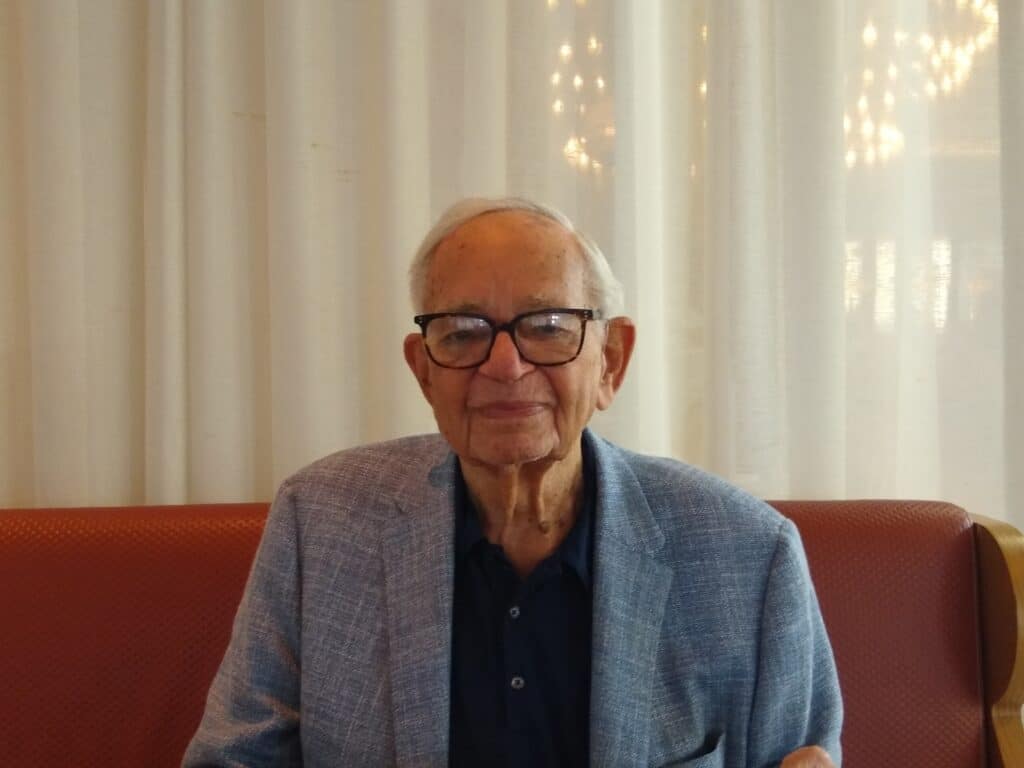 Leo Melamed, March 12, 2024 (Traders Magazine photo)
“I told them you may not like it, we will lose some jobs, but at the end of the day technology always brings more than it takes away,” Melamed said. “Besides, if we don’t switch to electronics, someone else will. Usually the first player wins. Second and third will get stones, but they won’t win.”
“Because we had Globex, we are what we are today: the largest and most efficient exchange in the world.”
Melamed said a testament to CME's strength was the exchange's opening for normal business on Monday, Sept. 15, 2008, the morning after the disaster of Lehman Brothers' bankruptcy filing. “That tells you everything you need to know,” he said. “The system is so vibrant, deep and well organized… This strength is unbeatable.”
CME's strength lies in the security of its clearing house, which Melamed said incredulously that an unnamed manager wanted to sell years ago. “Nowadays there is talk of every company carrying out its own clearing. I say absolutely not to that. I don’t trust anyone except the exchanges themselves.”
Overall, Melamed is optimistic about the currently hot technology – artificial intelligence. “In any field that has a long history of data, AI can do a lot of work and be of great benefit to humanity.” However, he expects AI to have minimal impact on trading and the direction and efficiency of markets . “The human brain is still the largest computer.”
When asked what he was currently doing, Melamed said: “Of course I still act, it’s in my DNA.”
“In addition, I continue to be an advisor to the IAC, the Chinese Advisory Council, a prestigious forum in which I served for many years. I also remain chairman of CMAC, the CME's Competitive Market Advisory Council, a think tank I co-founded with Nobel laureate Myron Scholes for the Merc in 2008, which is made up of several Nobel laureates and other financial experts who meet twice a year, to discuss topics relating to markets; Our last meeting was a discussion about artificial intelligence. It is also the forum that selects the recipient of the annual Melamed-Arditti Innovation Award.”
In the meantime, keep an eye out for “Cousins,” the sequel to “The Tenth Planet.” Melamed didn't reveal much about the plot other than pointing out an unexpected connection.
“Science fiction knows no boundaries,” said Melamed. “When I published my novel, some people said they weren't surprised at my science fiction leanings, since I do that for the futures markets.”
Comments are closed.