


Rostin Behnam, chairman of the Commodity Futures Trading Commission, said nothing has happened in the past year that could prevent another FTX.
Crypto exchange FTX filed for bankruptcy last year and founder Sam Bankman-Fried was found guilty of all seven criminal charges against him, including fraud. However, Benham also emphasized that the crypto market has changed significantly since FTX’s collapse and the exuberance has waned.
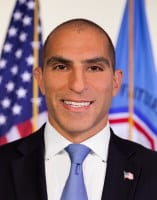
Rostin Behnam, CFTC
“Could an FTX-like event happen again?” he added. “I don’t want to say never, but the market dynamics are very different than they were a year ago, let alone two or three years ago.”
Behnam spoke Nov. 15 at the Financial Markets Quality Conference hosted by the Psaros Center for Financial Markets and Policy at Georgetown University.
Daniel Gorfine, founder of consulting firm Gattaca Horizons and an associate professor at Georgetown Law, said during a panel discussion on digital assets at the conference that the last few months have shown the limits of a regulation-through-enforcement approach. Therefore, comprehensive federal legislation is needed that provides clarity on definitions and ensures proper market oversight.
For example, in August this year, a court ruled in favor of digital currency asset manager Grayscale Investments against the US Securities and Exchange Commission. Grayscale had filed a lawsuit challenging the SEC’s decision to deny conversion of the Grayscale Bitcoin Trust into an exchange-traded fund, even though the regulator approved Bitcoin futures exchange-traded funds.
David LaValle, global head of ETFs at Grayscale Investments, said on the panel that the asset manager believes its product is in a perfect position to be converted into an ETF and listed on the New York Stock Exchange.
“We are getting significantly closer to being able to launch a spot Bitcoin ETF,” LaValle added. “We’re on the precipice of something that’s going to be really favorable for investors and that’s been in demand for some time.”
He continued that the SEC has a difficult task because ensuring investor protection is a very broad mandate. However, the regulator’s approval of Bitcoin futures ETFs indicated that they believed that the underlying spot markets were sufficiently monitored, so this was not a valid reason to deny approval of spot Bitcoin ETFs, which formed the basis of their legal proceedings.
“We raise our hand and say we want more regulation,” LaValle added. “We want to register our product and list it as an ETF on one of the most regulated markets in the world, the NYSE.”
An ETF structure provides access to the advisor market, including registered investment advisors, independent asset managers, broker-dealer wirehouses and the asset management platforms of major global banks. LaValle said Grayscale envisioned the Bitcoin ETF product would be launched in the same way the largest physical gold ETF was launched in 2004, as it would have similar complexities when it comes to storage and safekeeping.

David LaValle, Grayscale Investments
“Using this investment suite, proven in rising, falling and sideways markets, and the infrastructure of high-quality market makers, liquidity providers, global banks and authorized participants will enable investors to invest in Bitcoin with a high level of confidence.” he told LaValle.
Jason Monk, Director of Capital Markets and Digital Assets Product Strategy at Invesco, said on the panel that from an asset manager’s perspective, blockchain technology can be used to breathe life into assets that have traditionally been static and increase access to assets, which traditionally did not have a clear liquidity mechanism.
“Where it makes sense, tokenization of private market assets is very interesting,” Monk added. “We just need to find effective ways to do this without negatively impacting the underlying strategy.”
For example, private equity firms may not want their companies to trade 24/7 because they require some time to make changes and increase their value before making them available for a liquidity event.
Gorfine described tokenization as the creation of digital bearer instruments that bring benefits such as accelerated settlement and settlement as well as reduced counterparty risk.
“The blockchain conversation is about new transaction rails,” he added. “Tokenized assets can move on traditional rails, or you can think about distributed ledgers, where they move on interoperable and potentially open public systems.”
Public blockchains pose more risks, but also offer advantages in terms of access and the ability to communicate across different entities.

Daniel Gorfine, Gattaca Horizons
“I think all of these innovations are really important,” Gorfine said. “I think we will see them gradually evolve and change the way we transact most types of financial assets and instruments.”
LaValle emphasized that stablecoins can fill this gap between digital assets, which operate on one rail, and fiat or cash, which operate on an entirely separate rail.
Gorfine said: “Stablecoin regulation should be fairly straightforward and aligned with banking regulators to audit and confirm reserves.”
Voluntary carbon markets
Behman also said the CFTC is drafting guidance for the voluntary carbon offset market that has emerged in recent years and he hopes to issue it, subject to approval, by the end of November.
Carbon markets are based on trading allowances that allow a company to offset its carbon emissions and are divided into compliance and voluntary categories. Compliance markets are typically used by governments to set a carbon price through legislation or regulation by controlling the supply of allowances traded under a controlled emissions trading system (ETS). In contrast, voluntary markets are not required by law.
“The problem in this market is that there is no integrity, no regulation, and there are questions about the scientific methodology and how to measure impact,” he added.
However, companies registered with the CFTC list carbon futures that reference the underlying cash markets.
“That’s why we want to set standards for this market, assess integrity and credibility and scale the market to hopefully meet climate goals,” Benham said.

SUBSCRIBE TO NEWSLETTER
And get exclusive articles on securities markets
Comments are closed.