


|
Employees of the China Baowu Steel Group work in their steel mill in Maanshan in the Chinese province of Anhui. Baowu is the parent company of Baoshan Iron & Steel Co. Ltd., which has backup plans for 2022 that include up to 8 million tons of iron ore and 2.2 Mt of hot-rolled steel. |
A growing number of Chinese metals and mining companies have started using derivatives to hedge against unprecedented volatility in Commodity prices, despite risks that could prove catastrophic.
Global commodity prices have fluctuated in recent years amid the COVID-19 pandemic, the Russian war in Ukraine and the global energy crisis. Metals and mining companies in China have responded by hedging their bets in the financial markets. Generally, companies trade futures and options to hedge the trading prices of their commodities and products. They hope to secure revenue and reduce potential losses and gains.
55 Chinese companies in the metals, steel and coal sectors launched hedging programs in 2021, up 29% year-on-year and hitting a record high, according to calculations by S&P Global Commodity Insights, based on voluntary announcements by the Companies based in Shanghai Stock Exchange and the Shenzhen Stock Exchange. In 2022, 31 Chinese metals and mining companies published hedging plans as of April 13, up 14.8% from the same period in 2021.
But hedging is a double-edged sword, nickel traders learned on March 8 after nickel and stainless steel giant Tsingshan Holding Group Co. Ltd. attempted to cover a short position that was sending nickel prices soaring so rapidly that the London Metal Exchange halted trading and settled all trades made that day.
“Hedging should help companies reduce the impact of price fluctuations on their core business,” said Kenny Ng, a securities strategist at Hong Kong-based China Everbright Securities International, in an April 11 interview with Commodity Insights.

Protection against volatility
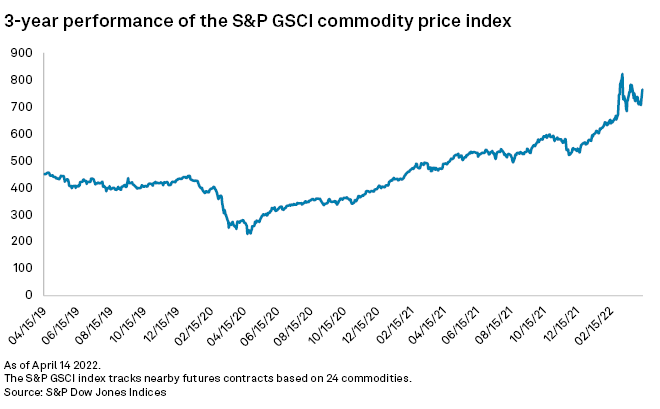
Raw material prices have risen sharply in recent years. The S&P GSCI index, which tracks 24 commodities, rose more than 260% from a low of 228.24 on April 21, 2020 to 822.3 on March 8, the highest since 2008 and has been steady ever since moving.
With some metal prices hitting historic highs, miners who fear metal prices will fall sharply this year could take a short position to avoid a potential shock to their earnings, Ng said.
However, if they have built a large hedging position and those predictions go awry, the losses will eat away at their gains, Ng said.
“For most Chinese miners, the main purpose of hedging is to prevent falling raw ore prices [to cause losses]Xia Yingying, a metals analyst at Nanhua Futures Co., told Commodity Insights on April 14.
In practice, these companies typically sell futures contracts covering the same quantity of ore to be sold in the spot market with a delivery date in the futures market that is the same as or close to the trade date in the spot market. Then miners can close out the futures contract position when they actually sell the ore on the spot market and lock in trading prices, the Hangzhou-based analyst said. Some miners use options that have more complex structures and offer more flexibility, Xia added.
Integrated metals producers are also looking to hedge against rising commodity prices.
“[The smelting segment] must use derivative instruments to secure processing profits and reduce operational volatility,” Wu Honghui, financial controller of Zijin Mining Group Co. Ltd., told investors in a call on March 21.
Zijin mainly conducts its smelting business in the domestic market, but relies on foreign raw materials and sells most of its products in the foreign market, Wu said.
Meanwhile, companies with overseas operations have started currency hedging. For example, leading steelmaker Baoshan Iron & Steel Co. Ltd. the usage currency swaps, iinterest rate swaps and structured products for its foreign currency Backup program in 2022 with a total no more than $15.99 billion.
China’s largest lithium company, Ganfeng Lithium Co. Ltd., plans to invest no more than 10 billion yuan in currency hedging in 2022, up from 5 billion yuan in 2021. Ganfeng uses Forward accounting, FX swaps and FX options for his FX hedging, Yang Manying, Ganfeng’s CFO and vice president, told investors on April 8. “In order to hedge the impact of interest rate and exchange rate fluctuations on operations, the foreign exchange hedging transaction will be conducted opportunistically according to market fluctuations,” Yang said.
These companies are preparing for a much larger swing in exchange rates, China Everbright’s Ng said. The US Federal Reserve entered a rate-hiking cycle in 2022, but China is expected to ease monetary policy further to counteract downward economic pressures from a resurgence of COVID-19, which could prompt foreign investors to pull money out of China, the strategist added .
Double-edged sword
While hedging strategies are designed to reduce risk and volatility, the use of derivatives involves risk.
The biggest risk Chinese miners face is that they may not find products in the futures markets that fully match what they produce, Xia said.
Tsingshan Holding Group Co.Ltd. faced $8 billion in paper losses after nickel prices more than doubled to a record high above $100,000/t on March 8 after Russia invaded Ukraine.

Tsingshan has built up a short position of 150,000 tons of nickel on the LME over the years through regular hedging, Bloomberg News reported. According to the report, the world’s largest nickel producer believed prices would fall after increasing nickel capacity for batteries in Indonesia.
Ideally short sellers such as Zingschan Borrow commodities and sell immediately, then buy back when prices fall. And they can return those commodities to the lenders and take advantage of the price differentials. However, the unprecedented rally in nickel prices forced Tsingshan provide more cash to meet minimum margin requirements, which also continued to rise with nickel prices.
Tsingshan could return nickel to the lenders. But the company produces mostly low-grade nickel pig iron compared to the high-grade metallic nickel it trades on the LME.
“The disparity between wealth and maturity turns around Tsingshan’s hedge against speculation,” said Gu Fengda, director of the research and advisory department of Guosen Futures, during a webinar on April 12.
Tsighshan’s derivatives division failed to issue early warnings and adjust hedging positions as nickel prices surged about 20% for about 20 days in January, Gu added.
Hedge against hedge
Other Chinese miners are more cautious. Zijin “has always been prudent in hedging” and hired a professional team to manage its complicated bets, Zijin’s Wu said. There is strict control over the amount of hedging and clear regulations over the stop-loss limit, and the shacks also have exposure limits, Wu added.
Zijin hedges no more than 4% of year-to-date production for mining products.
“We have been very cautious this year with a gold position of just over 300 kilograms, a copper position of only 500 tons watch positions, a zinc position of approximately 12,000 tons and a 40,000 tonne iron ore position. So overall position is very small,” Wu said.
On April 19, 1 US dollar was equal to 6.39 Chinese yuan.
S&P Global Commodity Insights produces content for distribution on S&P Capital IQ Pro.
Comments are closed.