


aluminum
By Christian DiClemente and Adrian du Toit
Financial markets offered few safe havens in 2022 and emerging market debt was no exception. We expect the difficult conditions of the past year to gradually ease in 2023, but risks remain and investors will have to be selective.
Global growth is expected to face severe headwinds this year, which could put pressure on commodity prices. Higher commodity prices are generally positive for emerging markets, especially when the US dollar is weak. The cycle over the past two years has been somewhat unorthodox, with commodity prices rallying alongside a strong US dollar. This created tensions between high and low quality loans, with lower quality loans suffering the most.
While commodity weakness would help contain global commodity inflation and reduce the risk of rising financing costs, it could also pose a challenge for commodity-dependent countries with high external financing needs – particularly those with negative basic balance sheets (Display) and limited access to the bond market.

Haver Analytics and AllianceBernstein
A possible end to rate hikes despite persistent inflation
If deteriorating economic conditions lead to a deep or prolonged cyclical bottom, the global policy cycle could turn around, although we generally expect an extended policy pause.
Emerging market investors are already seeing light at the end of the policy tightening tunnel. We believe the tightening cycle is more than 80% complete and there are increasing signs that core inflation is slowing. This means that one of the biggest macro headwinds for emerging markets – the tightening of global financial conditions – is fading.
However, inflation has been far from temporary and despite signs of disinflation, we do not expect inflation to return to pre-pandemic levels in 2023. This could limit central banks’ maneuverability and ultimately force central banks to accept higher inflation as a new normal.
China’s Pivot on Zero-COVID May Bring Hint of Stability
One reason for emerging markets’ lackluster performance in 2022 was China’s economic underperformance, partly due to lockdowns aimed at curbing the spread of COVID-19 infections. China’s decision to end its zero-COVID policy, while encouraging, is unlikely to improve growth prospects for emerging markets.
Still, this long-awaited economic reopening, combined with China’s low commodity inventories, could help stabilize commodity prices and emerging markets overall. At the very least, it will remove one of the biggest obstacles to asset prices in emerging markets.
Hardships remain, although defaults have probably peaked
While we could see an end to rate hikes in early 2023, policymakers are unlikely to cut rates as quickly as they have been able to in previous cycles. The monetary policy shift may be too late or the macro downtrend may be too strong to avoid problems in the emerging market frontier where credit stress is high (Display).
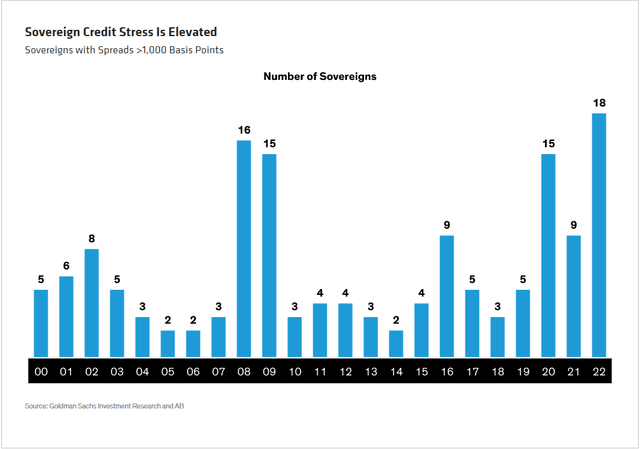 Goldman Sachs Investment Research and AB
But in our view, the worst of the sovereign default and restructuring cycle is behind us, and we do not believe that the default rates currently priced into emerging market assets will be realized in 2023. As a result, we expect a deepening sovereign crisis of a credit-specific and less cyclical nature. For investors, this means that careful issuer selection will be crucial, especially in lower-quality segments.
We are also keeping an eye on the more cyclical part of the market – particularly local rates and currencies. We believe the global economy is nearing a turning point as both inflation and growth slow. This could open the door to select opportunities in undervalued emerging market currencies or domestic rates markets.
New opportunities despite economic risks
As we move into 2023, we expect the correlation between duration and risky assets to turn negative again, which should improve the yield potential of emerging market debt. Nonetheless, investors should be realistic about the underlying challenges that could dilute a potential EM recovery, including lower long-term growth potential, higher debt burdens and ongoing geopolitical tensions.
Valuations remain mixed and investors should be cautious when assessing value through a traditional lens. Valuations have moved the most in distressed segments of the market, less so in government bonds with stronger fundamentals.
As the balance of risk continues to shift, we see select opportunities in three market segments:
- Lower quality corporate and government bonds that are best positioned to weather a downside global growth surprise – and where the probability of default is overrated
- Local currency government bonds where mature rate hike cycles and disinflation could support bond prices
- Undervalued currencies in emerging markets where monetary policy has already tightened and which could benefit from a weaker US dollar
We believe the stage has been set for a more constructive environment for emerging markets at the start of the year. As the balance of risk shifts in 2023, we see the potential for active investors to enhance returns through informed country, sector and security selection.
The views expressed herein do not constitute research, investment advice or trading recommendations and do not necessarily reflect the views of all AB portfolio management teams. Views may change over time.
Original post
Editor’s note: The summary points for this article were selected by Seeking Alpha editors.
Comments are closed.