


Tim Arbaev/iStock via Getty Images
“It’s different this time.” Four words that should scare investors, as Reinhart and Rogoff’s (2009) book of the same name eloquently demonstrates. As we enter a cycle of tightening this should certainly be endured but when you compare derivatives market conditions in 2020 to the current situation — as many are doing — it becomes clear that this time is really different.
On a superficial level, there are some similarities. Credit spreads widen in anticipation of higher defaults and banks increase risk provisioning. But on closer inspection, the markets behave very differently in the respective periods.
Take the CDS market for example. During periods of perceived credit deterioration – both in March/April 2020 and today – CDS tend to attract more interest and trade in higher volume. This reflects its usefulness in hedging credit risk as well as its flexibility in alpha generation strategies.

Chart 1. Notional traded in CDS indices (5-day moving average)
Source: OSTTRA/ S&P Global Market Intelligence. Data compiled on April 22, 2022
While there were higher volumes in 2020 and 2022, chart 1 shows that the magnitude and duration of the upturn varied. In March and April 2020, as markets reacted to the outbreak of the COVID-19 pandemic, volumes in the CDX IG and iTraxx Europe increased dramatically. In contrast, volumes were already increasing in the last quarter of 2021 and continued to do so in the first quarter of 2022, albeit to a lesser extent. Note that both periods included an index roll, which is bound to boost volume. But the differences between periods are clear, both in scope and longevity.
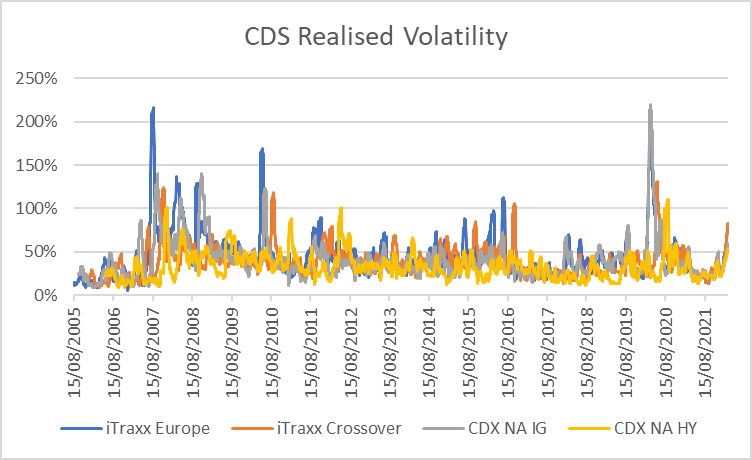
Chart 2. Realized volatility (20 days) in CDS indices
Source: S&P Global Market Intelligence. Data compiled on April 22, 2022
The fear and uncertainty permeating the market – reflected in the volatility of asset prices – offers another stark comparison. The realized volatility of the CDS indices reached levels in line with the GFC before quickly recovering to more ‘normal’ levels. Although volatility has been increasing since Q4 2021, it has been steadily increasing and the levels – while high – are nothing out of the ordinary and a fraction of what we saw in March/April 2020.
The rampant uncertainty triggered by the pandemic led to a significant reduction in liquidity, a factor that exacerbated volatility. The loss of liquidity was evident even in traditionally resilient instruments like US Treasuries, so it was not surprising that it was noticeable in derivatives. As we have already seen, activity in the CDS indices has been consistently strong. For single-name CDS, the picture was more mixed.
Chart 3 shows the dispersion of trader contributions to S&P Global* composite CDS levels. The 5-year term is by far the most liquid and the diversification is therefore narrower than in the other terms. Nonetheless, the feverish conditions of 2020 caused dispersion to increase significantly before returning to trend. This pattern was even more pronounced at the less liquid short and long ends of the curve.

Chart 3. Spread of single-name CDS contributions
Source: S&P Global Market Intelligence. Data compiled on April 22, 2022
There were indications that current market conditions have increased dispersion. But the impact is modest and reasonable compared to 2020.
One may wonder what the tangible impact of increasing price dispersion is on financial institutions. The EU Prudent Valuation Regulation will have a direct impact on European banks. This was introduced in 2016 to ensure that instruments valued at fair value are valued prudently – taking into account additional factors such as market price uncertainty (effectively diversification), concentration risk and several others. The higher the spread, the higher the additional valuation adjustment, with a corresponding negative impact on Core Equity Tier One (CET1) capital.
In 2020, the European Banking Authority (EBA) amended the Prudent Valuation Regulation by increasing the aggregation factor from 50% to 66%. This aggregation factor reflects that some individual AVAs overlap when aggregated at the category level. The increase in the aggregation factor therefore gave the banks a significant relief in terms of capital requirements due to the greater uncertainty and diversification.
This provision has long since expired and the EBA has refrained from taking similar measures in the current period. That this is not the case perhaps reflects the differences between 2020 and 2022 highlighted above. In 2020, the EBA highlighted the “extreme volatility” that had caused the Prudent Valuation Regulation to have an “overly procyclical effect”. As we saw in Chart 2, volatility has increased in 2022, but it cannot be characterized as extreme (although there may be evidence of extremity in other asset classes such as commodities).
The current period is in some respects a more typical shift in the business cycle. Inflation is rising – exacerbated by the Russia-Ukraine conflict – and central banks are tightening monetary policy as a result. The positive credit momentum of the past 14 months has been halted, with S&P Global Ratings expecting default rates to rise to 3% in the US and 2.5% in Europe (although uncertainties may drive defaults above forecasts).
Pricing can be challenging away from the very liquid part of the financial markets. This remains the case and both cash and derivative instruments are susceptible to price dispersion. This can create uncertainty and is directly impacted by regulations such as Prudent Valuation. But it can also have implications for valuation uncertainty in a broader context, not just for banks but also for buy-side institutions such as wealth managers. With the market disruptions evident in 2020, this is an evolving theme. So far, this has not happened again, but market participants must be prepared for such events in a more volatile world.
* Calculated as the sum of the standard deviations of the traders’ passed contributions divided by the consensus of the conventional spreads
Original post
Editor’s note: The summary bullet points for this article were selected by Seeking Alpha editors.
Comments are closed.