


Adène Sanchez
Bristol Myers Squibb (NYSE:BMY) has definitely been a great stock over the past few months. It took two years for investors and an increasing demand for safer skies to take notice of this pharmaceutical company. During the S&P 500 (SPX) is still in bear market territory, Bristol Myers Squibb shares continued the strong momentum they built in November 2021.
From the bottom, the stock is up almost 50% through June, which is impressive for such a large pharma stock, especially in this macro environment. As shown in the chart below, Bristol Myers has had a strong negative correlation to the S&P500, making it a strong addition to a standard portfolio to reduce volatility.
 BMY data from YCharts
But it also shows that the stock has shown some signs of weakness over the past few weeks amid some financial news and pipeline updates. Investors might be concerned if it’s time to sell their gains or if it’s just a bit of an overreaction. In the following, I will therefore put the news of the last few weeks in a fundamental context.
Pipeline Updates
Since my last update on Bristol Myers Squibb in February, there have been a few developments in the pipeline. Advances in this area are particularly important for the company at this time to offset declining sales of Revlimid, Abraxane and soon Pomalyst. A long-term plan was drawn up for this some time ago, but the necessary permits must also be obtained.
For example, the approval of the combination of nivolumab and relatlimab for the treatment of advanced melanoma was important. It’s marketed under the Opdualag name and has already put in a compelling start at $58 million in Q2. Management expects Opdualag to reach a sales peak of US$4 billion. Therefore, the first registration of the product on the US market is an important milestone, however, some registration extensions are required in the coming years in order to exploit the sales potential.
Another important milestone for the future was the approval of Mavacamten, which was given the product name Camzyos. This was important because it was the primary reason Bristol Myers Squibb decided to acquire MyoKardia for $13 billion in late 2020. Accordingly, failure of the compound in phase 3 would have been a disaster for the company and confidence in further M&A transactions.
This makes Camzyos the only approved active ingredient on the market that specifically targets the cause of hypertrophic obstructive cardiomyopathy. Again, the company anticipates a combined sales potential of $4 billion, including some regulatory expansions.
In addition, there was a successful approval extension for Breyanzi in Europe and the US for relapsed or refractory large B-cell lymphoma after prior therapy, as well as two additional approvals for Opdivo and some encouraging phase 2 study results for deucravacitinib. Many important milestones were already reached in the first half of the year. Recently, the FDA approved Sotyktu (deucravacitinib) as an oral treatment for adults with moderate to severe plague psoriasis, which is also good news. But now to the bad news.
In my last analysis, I highlighted Bempeg, among others, as a big hope for a nex-gen successor to Opdivo. Unfortunately, the results of the phase 3 study were disappointing in all areas examined and the project in collaboration with Nektar (NKTR) was terminated.
The next setback had a significant impact on the share price. The company presented phase 2 study data for the blood thinner Milvexian, which came in weaker than expected. According to Bristol Myers Squibb and partner Janssen, the primary target was missed. However, there were some encouraging results and the two companies decided to proceed to phase 3.
However, the stock reacted with a significant discount of 5%. The two setbacks impact the potential of the mid-term pipeline, but the key approvals and progress have been made, so I remain positive about their pipeline.
Financial update
In February, my estimate for the fiscal year was $47.2 billion, which was within the company’s guidance of $47 billion. But already in the first quarter of 2022, management adjusted the forecast to a level “in-line with 2021”. Accordingly, the new target is around $46.5 billion. That’s a little disappointing, as management was previously extremely confident that it would continue to grow even after Revlimid is discontinued.
The fact that this target is already being discarded in the first quarter of the generic competition, at least for 2022, is somewhat destroying investor confidence. While Revlimid and Abraxane sales are projected to hit $10.5 billion in 2021, the new estimate for Revlimid is $9 billion to $9.5 billion, and Abraxane is highly unlikely to hit any in 2022 sales will reach one billion.
Accordingly, the generic counter-expansion for Revlimid appears to be slightly stronger than expected. At least the outlook was not lowered again in the second quarter, which is an encouraging sign for the time being.
In my view, another reason for the cautious outlook is the somewhat sluggish sales development of the new product line. Here is an overview of the products approved since 2020:
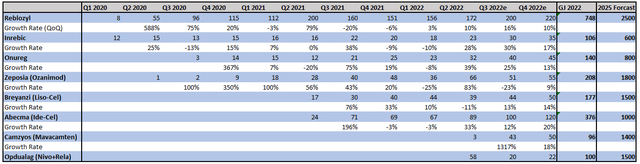
Bristol Myers Squibb Quarterly Reports, author’s calculations
At first glance, given the high growth rates, the developments look quite appealing. However, one has to consider the low basis of comparison and also the growth targets that management has set for the products. Reblozyl, for example, had a strong start to 2020 but has lost massive momentum since the second quarter of 2021 at $200 million levels.
That’s a little surprising given that it’s expected to hit $2.5 billion in revenue in 2025 and up to $4 billion in 2029, according to management. A similar situation can be observed with Inrebic, Onureg and Breyanzi. The only positive exceptions here are Zeposia and Abecma. Overall, revenue from the new pipeline was just $450 million in the second quarter. It’s up to management to prove in the coming quarters that its guidance of $10 billion to $13 billion by 2025 for these products is still realistic, or whether it was overly optimistic.
In any case, I have become somewhat more cautious with my assessments, both in the short and medium term. This is reflected here in my overview of the next few years:

Author’s calculations
rating update
Despite the reduced valuations, Bristol Myers Squibb remains fairly attractively valued. The price-to-sales ratio of 3.2 remains close to historic lows, while the forward P/E of 9 is also far from a high valuation. The discounted cash flow model offers a somewhat better overview. I calculated the following assumptions.
- Sales development up to 2029 as outlined above
- Average free cash flow margin of 34%.
- Shares outstanding to 2,000 million including share repurchases
- WACC 9%
- Terminal growth rate 0%
These assumptions bring me to a fair value of $107, which is a potential 55% upside from current levels. This is quite attractive considering I made fairly conservative assumptions. In addition to the share buyback programs, we can expect significant dividend increases in the coming years. For these reasons, I think Bristol Myers Squibb is very attractively valued.
bottom line
Bristol Myers Squibb stock has been among the winners so far in a challenging year and a weak market environment. This speaks for a robust business model and a certain resilience to external factors. There have already been some milestones in the form of positive study data and approvals that should secure the company’s sales in the medium term.
However, there were also two disappointments which, combined with a cautious outlook, led to some caution among investors. Management needs to demonstrate the sustainability of its growth strategy through 2029 in the coming quarters.
Still, the stock has already anticipated some risks and disappointments here, which is why I think it’s an attractive buy even considering the share buybacks and rising dividend.
Comments are closed.