


Andriy Dodonov
Rising interest rates have made for a bad year for bonds. The best performers in fixed income are those with short maturities and/or variable rates, such as senior loans.
Rising interest rates mean higher returns for investors senior loans. At the same time, this means higher interest payments for borrowers. And these higher interest costs come at a time when the economy is slowing due to the Fed’s rate hikes. A double whammy. We expect inflation to remain above the Fed’s 2% target for years to come, and as such we believe there is little scope for truly lower interest rates.
We favor senior loans when interest rates are rising and delinquencies are low due to a booming economy. We like them less in the more stagflationary environment we think we’re in at the moment, with rising default rates.
Our preferred senior loan ETF is the Invesco senior loan ETF (NYSEARCA:BKLN) due to its good performance and low cost ratio. Hold onto your shares and enjoy the high coupons and diversification benefits while waiting for the economy to improve (before increasing your position).
What are Senior Loans?
Senior loans are also known as bank loans, leveraged loans or syndicated loans. A senior loan is a commercial loan to a high-yield company provided by a (syndicated) group of lenders. They are often used to fund leveraged buyouts. These loans are typically senior debt (secured by the assets of the borrower company) and are at the top of a company’s capital structure.

Figure 1: Senior Loans in the capital structure (Investco)
Typically, senior loans are the first to be repaid during bankruptcy resolution. As a result, senior loans have double the payback ratio of “regular” high yield bonds and exhibit lower volatility than high yield bonds.
Thanks to this lower volatility, senior loans offer investors more diversification benefits.
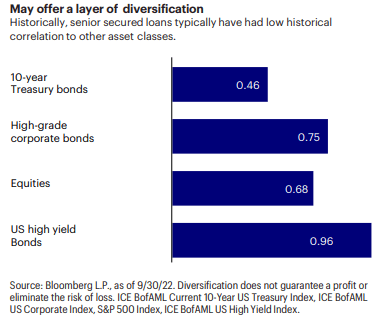
Figure 2: Diversification benefits (Investco)
Senior loans are very often floating rate and historically priced at a spread above a reference rate such as SOFR (Secured Overnight Financing Rate) or LIBOR. The spread compensates investors for the credit risk they take by lending money to a high-yield company.
Because they are floating rate senior loans, they have a very short term. They are less sensitive than other bonds to rising (or falling) interest rates. When interest rates rise, the coupon payment increases, but the price remains fairly stable. In the case of (high-yield) bonds, the price falls when interest rates rise and the coupon payment remains stable.

Figure 3: Effects of rising interest rates (Investco)
Of course, changes in default risk can affect the price of senior loans regardless of rising or falling interest rates.
default risks
Over the past decade, the term “Cov-Lite” has become virtually synonymous with senior loans, dominating more than 90% of the market. Cov-lite stands for “Covenant-lite”. Debt obligations included in bank loans are an important source of investor protection because lenders can demand immediate repayment of the loan if an obligation is breached.
Typically there are two types of debt agreements: positive and negative.
Affirmative covenants are straightforward and require the borrower to take basic actions related to the loan (e.g. pay interest).
Negative covenants are more tailored to the company’s situation and concern restrictions on the company’s operations (e.g. mergers and acquisitions, dividends, asset sales).
Negative covenants take two basic forms: creation and maintenance.
Incurrence covenants require the issuer to meet certain financial tests only if the company intends to take a specific corporate action (such as paying a dividend or issuing additional debt).
Maintenance covenants are more restrictive, forcing issuers to pass certain financial tests each quarter (even if there are no specific actions management wants to take).
Senior loans issued with only incurrency covenants and no maintenance covenants are classified as cov-lite. The vast majority of leveraged loans today are classified as cov-lite. This means fewer restrictions on the borrower and the potential for even more debt issuance.
The added flexibility for issuers with no maintenance obligations can allow these borrowers to avoid a default. You can’t do without alliances that aren’t there. On the other hand, a lack of maintenance obligations can delay a default for some time, but when it does, it can result in lower recovery rates for lenders.
In addition to the “light” covenants, many senior loan borrowers have taken advantage of the low interest rates and refinanced in recent years. As a result, no senior loans are due in 2022, and the amount due in 2023 is down about three-quarters since early 2021.
Only 9% of outstanding senior loans will mature before the end of 2024, according to the Morningstar LSTA US Leveraged Loan Index. This could help high-yield companies weather the economic weakness caused by the FED rate hikes. However, failure rates are currently very low.
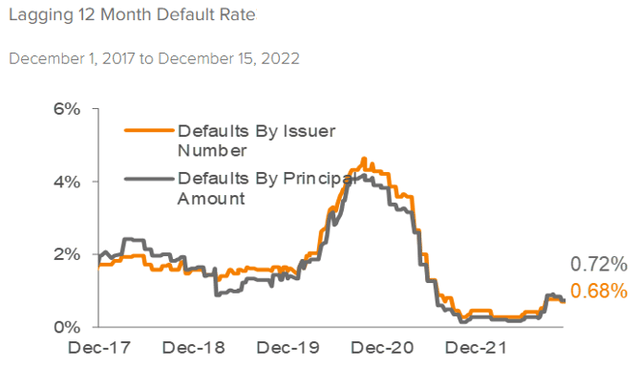
Figure 4: Failure rate (Voya Investment Management)
But according to Fitch Ratings, the outlook for US leveraged finance is deteriorating in 2023. Fitch’s default rate expectations for 2023 are 2.5%-3.5% for high-yield bonds and 2%-3% for senior credit, reflecting growing macroeconomic conditions indicates a headwind, e.g. B. the mild US recession that Fitch expects in mid-2023.
Of course, if we experience a really hard landing, failure rates will be higher. At the same time, a hard landing could force the Fed to cut interest rates, which should lower interest costs.
Where are interest rates headed?
Senior loans can benefit an investor in both rising and falling interest rates. When interest rates fall, the positive effect is usually limited to reducing the volatility of a (bond) portfolio. When rates rise, senior loans are the top performers, as we’ve seen this year. So where interest rates are headed is important.

Figure 5: Impact on interest rate movements (Nuveen)
In December, the Fed raised the key interest rate by a further 50 basis points. What’s next? Based on futures markets, there is a 66% chance that the Fed will hike 25 basis points at the next FOMC meeting in February. There is a 56% chance of another 25 basis point rate hike in March. This would put the Fed rate in a range of 475 to 500 bp. This meeting would mark the end of rate hikes, according to futures markets. The May FOMC meeting would leave the Fed rate unchanged.
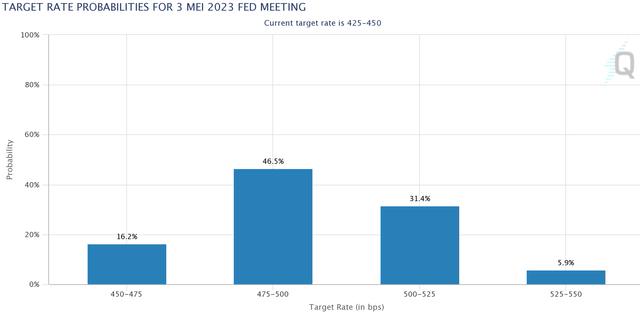
Figure 6: Target price probabilities for May 2023 (CME group)
So there is still limited scope for higher coupons on senior loans due to persistent inflationary pressures. It remains to be seen whether the borrowing companies will be able to pass these higher prices on to their customers. Otherwise, they not only face higher interest costs, but also pressure on margins.
According to the FOMC dot plot, the FED expects rates to remain at this level through the end of 2023 and fall to 4% by 2024. In the dot plot below, prepared by CME Group, the red dots indicate where the futures markets expect the FED rate to be. At the end of 2025, the futures market expects the Fed rate to be above 3.5%, while FOMC members expect the rate to be just over 3%.

Figure 7: FOMC scatter plot (CME group)
So 2023 could bring both the highest interest rates in years and an economic slowdown. If this turns out to be true, it hits senior loan borrowers twice: falling income and high interest costs.
Of course, if the economic slowdown is severe, the Fed must lower interest rates, and this would ease the situation for senior borrowers (due to lower interest costs).
Invesco Senior Loan ETF
Our favorite way to play the senior loan market is the Invesco Senior Loan ETF. BKLN has an expense ratio of 0.66%, while underperforming competitors like SPDR Blackstone Senior Loan ETF (SRLN) and First Trust Senior Loan Fund (FTSL) have expense ratios of 0.70% and 0.86%, respectively.
The Invesco Senior Loan ETF is currently yielding 6.7% and has nearly $4 billion in assets under management.
The ETF is based on the Morningstar LSTA US Leveraged Loan 100 Index. BKLN typically invests at least 80% of its total assets in constituent securities. The Index is designed to reflect the market-weighted performance of the largest institutional leveraged loans based on market weights, spreads and interest payments. The ETF and the Morningstar LSTA US Leveraged Loan 100 Index are rebalanced and recomposed semi-annually in June and December.
Most loans in BKLN are rated B and BB.
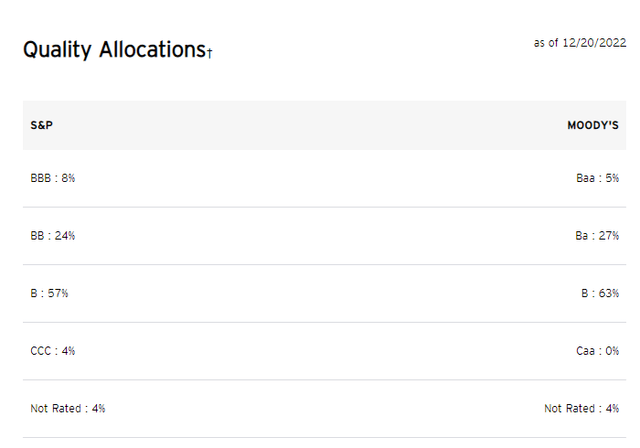
Figure 8: Rating assignment (Investco)
BKLN not only diversifies, it is also well diversified with a total of 135 holdings. The largest position accounts for less than 2% of the fund.

Figure 9: Top 10 Holdings (Investco)
Conclusion
When do you want to buy senior loans? When you have a booming economy that results in rising interest rates and low risk of default. That doesn’t really describe the current situation.
When do you want to hold senior loans? I would almost always say. Not only for the nice yield. They deserve a place in fixed income portfolios as a diversifier and volatility reducer.
When would you sell? When you have a severe recession and the central bank doesn’t cut interest rates to fight that recession. We think this combination is not the most realistic scenario.
So our conclusion is clear: hold your Invesco Senior Loan ETF, enjoy the nice yield while you wait, and consider adding to it when the economic outlook improves again.
Comments are closed.