


tiero/iStock via Getty Images
Co-produced with “Hidden Opportunities”
We often hear that investors should “buy low and sell high.” However, during a market correction (or bear market) investors rarely see it as an opportunity to buy cheaply like a holiday sale. Instead, investors are panicking as if stock prices are about to fall indefinitely and trying to sell to “cut my losses.”
In reality, market volatility is comparable to severe turbulence in air travel. While passengers and pilots may not appreciate the plane’s uncontrolled movements, in general everyone is aware that the plane and passengers will most likely survive.
This is true of any portfolio when it experiences volatility. Up or down, investors panic and make bad decisions. Often these decisions are made when investors have less confidence in their choices. They don’t sell after seriously considering the actual financial implications for the businesses they own. Instead, they react to the price movement.
Over the past four decades we have faced the 1987 crash, the 2000 DOT-COM crash, the 2008 Great Financial Crisis, the global pandemic and its aftermath. In addition, the financial markets have flown through much more turbulence in between with a “correction” every 1-2 years. Today we’re grappling with another bout of stock market turmoil, and it’s important to keep two investment rules in mind:
-
Never make trading decisions based on news.
-
Structure your portfolio in such a way that short-term results do not matter.
Let’s see what legendary investor Warren Buffett has to say.
“I never try to make money in the stock market. I buy on the assumption that they could close the market the next day and not reopen for five years.” – Warren Buffett
The short-term is less important when we invest for income; You can safely ignore market volatility and buy when yields rise. With an income strategy, you don’t buy with the aim of selling at a higher price. You buy stocks to receive a portion of the underlying company’s profits as dividends. The price of the stock doesn’t matter, the profitability of the company does.
Today we discuss two robust picks with returns of up to 8.3% from the energy sector. This vital sector is currently the cheapest on the market and represents a valuable opportunity. Without further ado, let’s discuss how to stay calm in this chaotic patch.
Choice #1: MMP, Yield 8.3%
Energy independence is a much discussed topic today. Midstream companies are a crucial asset as energy commodities procurement enters serious negotiations on a global scale. Finally, goods need to be stored and transported across geographic locations, regardless of their origin.
Income investors love the midstream industry, and today we’re discussing it Magellan Midstream Partners (MMP), a high-value midstream company serving refined products and crude oil needs in the United States
-
Refined Products – MMP operates a 9,800-mile refined petroleum products pipeline system with 54 connected terminals and 47mm drums with storage capacity. This segment accounted for 77% of revenue in 2021.
-
Crude Oil – MPP operates over 2,200 miles of crude oil pipelines, a condensate splitter and 37 million barrels of aggregate storage capacity. In 2021, this segment accounted for 23% of Group sales.
MMP is a master limited partnership that issues a Scheme K-1 for tax purposes.
MMP is trading cheaply at 11x EV/EBITDA compared to 13x to 15x multiples of midstream peers. Management recognizes this undervaluation and has aggressively conducted share repurchases of approximately $523 million of common stock during fiscal 2021. MMP still has $700 million to make further buybacks. Over 7% of MMP’s common shares have been repurchased in the last two years, significantly increasing the distributable cash flow (‘DCF’) per share and improving distribution coverage. Remember, when an MLP buys back stock, it directly benefits shareholders. Think of a large pizza sliced into 6 slices instead of 12; everyone gets a larger portion!
MMP pays an aggregate interest rate of 4.4% on its $5 billion long-term debt ending in 2025. This provides MLP with significant cash flow flexibility to conduct investing and capital return activities. The company has maintained steady payout increases for 20 years, and currently its $1.0375/share payout boasts a healthy annualized return of 8.3%. MMP’s distribution in 2021 was 1.2x covered by its DCF. We expect this coverage metric to improve in 2022 as we face a challenging commodity super cycle fueled by geopolitical tensions and rising global demand.
Pick #2: AY, yield 5.1%
Increasing the overall contribution of renewable energy is crucial to achieve the goal of energy independence. Atlantica sustainable infrastructure (AY) owns a diversified portfolio of resilient and mission-critical renewable energy, efficient natural gas, electrical transmission lines and water infrastructure. The company’s renewable energy sector accounted for about 74% of sales in 2021, with solar being the most significant. AY owns, manages and operates infrastructure in North America (US, Canada and Mexico), South America (Peru, Chile and Uruguay) and EMEA (Spain, Algeria and South Africa). (Source: Q4 presentation Feb. 2022)

Q4 presentation February 2022
In 2021, AY revenue grew 20% year over year, while Adjusted EBITDA showed 12% growth. While the year-over-year decline in EBITDA margin is noticeable, it’s important to note that the company invested ~$480 million in 2021 to expand its asset base. The majority of these investments were made to strengthen and expand operations in North America.
AY works under long-term contracts with investment-grade partners, government agencies and other companies. The Company’s assets have a weighted average remaining contractual life of approximately 16 years. This is how AY produces stable cash flows and receives consistent dividend payouts.
90% of AY’s long-term debt is fixed-rate or hedged, meaning the company will be little affected by Fed rate hikes. In addition, approximately 52% of AY’s cash available for distribution (“CAFD”) is indexed in some way to provide a hedge against inflation. It gets better; AY has also taken advantage of the low interest rate environment by cutting its net interest rate to 5.2% (from 6.9% in 2020). AY’s average corporate debt maturity is ~5.2 years, indicating the company’s tremendous near-term flexibility in terms of its cash flow.
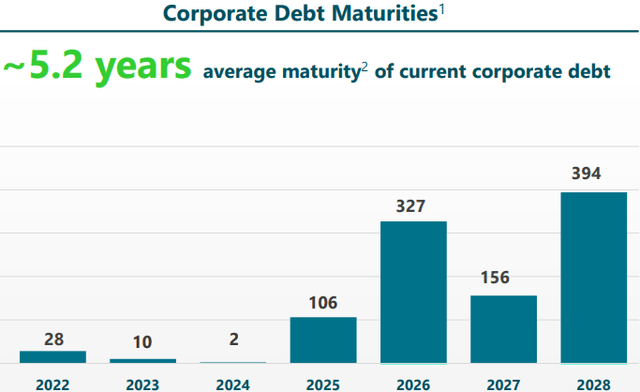
Q4 presentation February 2022
AY’s current quarterly dividend of $0.44/share reflects an annualized yield of 5.1%. In five years, the company has enjoyed an impressive CAGR dividend growth of 12%. AY forecasts CAGR CAFD growth of 5-8% through 2025, which means investors can continue to expect growing dividends for the next few years.
 Data from YCharts
2021 CAFD of $2.03 covers 115% annual dividend! Remember that CAFD is the component of operating cash flow that is calculated after capital costs are removed. This means that the company can distribute this amount well despite CapEx projects to expand its infrastructure. You would be relieved to know that 90% of AY’s CAFDs are in US dollars, which is a comfort in these times of geopolitical tension.
AY is a solid pick for dividend growth in a sector that will continue to experience global political tailwinds for the foreseeable future. This is your chance to collect a well-covered 5.1% return and the opportunity will not last.

Getty
Conclusion
As stock prices rise, investors feel increasingly confident. That confidence wanes when stocks fall. Confidence turns to pessimism and everything the bears say will start to make sense. Investors panic and try to get out before it’s too late to either capture the remaining profits or cut their losses and stay cash while waiting for the tide to turn.
This emotional roller coaster ride is time consuming, mentally draining and totally unnecessary. The world won’t end. And if you do, you have bigger worries than your investment portfolio. If the companies you invest in are of high quality, they will survive and thrive as economic conditions change.
There is no shortage of news surrounding financial institutions during the bull and bear phases of the market. Rising stocks receive price increases and falling stocks receive price downgrades. Remember, Wall Street analysts don’t work for you. Their price hikes can quickly turn into harsh downgrades if the broader market declines and they are under no obligation to give you a trade recommendation at the right time.
“I’m not buying them because I think they’ll be out in the next day or next week” – Warren Buffett
Investors like Warren Buffett look at much more than current events when making their purchases. They view buying a stock as buying a company.
Buying stocks for income will make your decision making easier. They simply buy more of your high-quality, income-generating picks as they fall. During the turbulent period, your portfolio will reap dividends (yes, you can reinvest them to automate the “buy-the-dip”), and you can avoid much of the panic and stress that most investors go through when trying to time the market.
Today we’ve discussed two tips with returns of up to 8.3% to help you weather this market turmoil. Both come from the heavily discounted energy sector and are solid dividend-paying companies. The best time for an income investor is when the markets are panicking. With discounted prices, you can secure high returns and beat the turbulence while getting paid in the process!
Comments are closed.