


A smaller workforce will dominate the economy in 2024. In fact, this will be the most important economic challenge we face in the foreseeable future. A labor shortage will be hard on businesses, but for some consumers it also means they will always be able to find a job that can cover their expenses. This puts a limit on any economic weakness in 2024.
A smaller workforce is key to understanding future economic trends
Our workforce is too small for simple demographic reasons. The baby boomer generation was more than three times larger than the generation before it, the Silent Generation. As boomers entered the workforce in the early 1960s, labor force participation rose sharply.
However, the next generation, Generation X, was smaller than the Boomers. The Millennial generation is only slightly larger than the Baby Boomers and Generation Z is slightly smaller than the Millennials.
This has created a demographic shortage of workers. It is ideal for economic growth if subsequent generations are taller than those before them. Visualized it should look like a triangle, with the younger generations being taller than the previous ones. Instead we have an inverted triangle.
This means that as baby boomers retire and leave the workforce, there will not be enough workers in the younger generation to fully replace them. Baby boomers will continue to be big spenders and consumers, so companies will still have to meet strong demand, but with a smaller labor pool.
Impact of labor shortage on the economy in 2024
The economy is expected to slow in early 2024 as consumer spending is expected to slow. To keep their spending above inflation, consumers have relied on the savings they accumulated during the pandemic and the credit card balances they paid off. Pandemic-era savings are largely gone to those who need them most, and credit card balances have ballooned. The capacity to take on further debt will be limited in 2024.
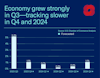
This will weaken spending and growth. The economy grew over 5% in Q3 2023 and is expected to grow over 1% in Q4. In 2024, growth is expected to slow even further. For example, the chamber assumes that the economy will only grow by just under 0.2% and 0.4% in the second and third quarters. That's a far cry from the growth seen in the third quarter of 2023.
The labor shortage will limit the economic slowdown as the number of job vacancies will continue to far exceed the number of unemployed people. Additionally, wages have increased significantly and are likely to continue to do so as demand for labor exceeds supply.
Economic headwinds are finally taking their toll, perhaps enough for a recession
Even with abundant jobs and strong wage growth, the combined effects of less savings, more credit card spending, higher interest rates and persistent inflation will weigh heavily on the economy in 2024.
The economy has still not fully absorbed the impact of the higher interest rates that were necessary to combat inflation, and these higher interest rates will continue to weigh on the economy.
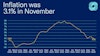
Although inflation is falling, it remains above the Federal Reserve's (Fed) 2 percent target. That means it continues to place a significant strain on consumers' budgets and reduces the chances that the Fed will be able to cut interest rates soon.
All of these factors lead to a decline in consumer spending and a slowing economy in 2024 compared to a solid economy in 2023.
Whether the slowdown in consumption will trigger a recession remains an open question. It's possible that the combined force of these headwinds could trigger a recession in 2024. A recession is defined as two consecutive quarters of negative economic growth.
The last time we had two quarters like this was the first and second quarters of 2022. Not many people remember these six months as a recession because key economic indicators such as jobs, spending, income and output during this period – the first – all fell The times they did so were during a recession. The first half of 2022 will be largely forgotten as a recession because the American people, on average, did not feel economic pain at that time.
A similar scenario could occur in 2024. The economy could slow, perhaps to the point where it meets the technical definition of a recession, but because companies need workers so badly, mass layoffs won't happen. In fact, companies can continue to hire even if the economy slows. In this case, there could be another recession in which the American people would not suffer major economic problems.
Read more
Forecast for the end of 2024 and beyond is better
Once we emerge from this slowdown, the outlook for the U.S. economy is optimistic for the remainder of 2024 and into 2025. When an economy is hit by shocks, bubbles within the economy usually burst or weaknesses are exposed. We have experienced three major shocks in a row over the last three years (COVID-19 pandemic, inflation and higher interest rates) without any negative impact, suggesting that the underlying economic situation is stable.
As soon as inflation continues to fall and the economy can better cope with higher interest rates, it should grow strongly.
Risks to the positive prognosis
As always, there are risks that could jeopardize the optimistic outlook. There are always unknowns, black swans, events that no one can predict and that could endanger the economy – for example a pandemic.
However, there are even more concrete threats to the economy in 2024. The most risky scenario is a sharp decline in the office space market. The prices for office buildings in urban centers have fallen sharply due to higher vacancies and higher interest rates. This puts their owners and their lenders in a difficult position and could lead to a credit crunch at major regional banks. These banks are major lenders to small and medium-sized businesses and the largest lenders to office complex owners. These banks will have to reduce their lending while recovering their losses on office space loans.
Geopolitics could also harm the economy. An intensification of wars between Russia, Ukraine and Israel and Hamas could destabilize the global economy, which would harm the US economy. And there is always the possibility that an unforeseen conflict may arise.
Finally, there is still a domestic political risk in the USA. Congress still needs to pass a budget for fiscal years 2024 and 2025. He must also raise the debt limit before January 1, 2025. Failure to do so would mean a blow to the economy.
Bottom line
As always, the economy faces major challenges in 2024. The labor shortage means consumers will be better equipped to weather a potential slowing economy early in the year. This also means that the slowdown is likely to be mild and the economy is expected to recover strongly.
About the authors

Curtis Dubay
Curtis Dubay is chief economist for the Economic Policy Division of the U.S. Chamber of Commerce. He leads the Chamber's research on the U.S. and global economy.
Read more
Comments are closed.