


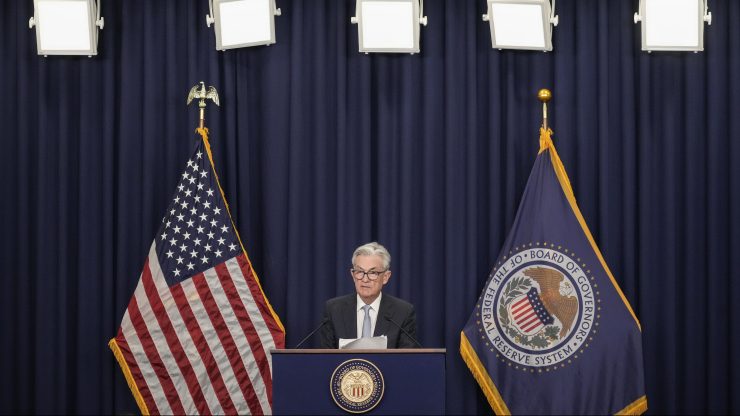
Those interested in understanding the Fed’s mindset might want to consult the panel’s quarterly Summary of Economic Projections report.
Drew Angerer/Getty Images
For decades, the Fed was mysterious; predicting what it would do was an art form.
When Alan Greenspan was chairman, people watched his briefcase as he entered the Fed building. If it was bulging, the thought was that it was filled with evidence he would use to push for a rate hike. But since 2007 we have the Summary of Economic Forecasts, which is published four times a year. Its name makes it sound like some sort of crystal ball, but that’s not quite the case.
“I would call this a poll — it’s like an opinion poll,” said Andrew Levin, an economics professor at Dartmouth College and a former Fed economist.
Levin helped design the executive summary and a series of questions for the panel of Fed governors and regional Fed bank chairs that sets interest rates – the Federal Open Market Committee.
“The poll is usually conducted in the last few days before each policy meeting,” Levin explained. “You fill out a survey form and then the Federal Reserve staff tabulates it.”
The survey asks the committee questions such as: What will happen to the unemployment rate, inflation and economic growth this year, next year and in the longer term? And what are reasonable interest rates during this period?
Former Philadelphia Fed President Charles Plosser worked with Levin to help prepare the economic forecast summary. The goal, he said, “is about communication and transparency.”
Transparency about interest rates and their development. According to Plosser, the summary also makes the Fed’s job easier because it helps investors anticipate what the central bank will do.
“Policy can be more effective and beneficial when the public and markets better understand what the Fed is doing and why,” he said.
But Plosser said some people take the word “projections” too literally. The Fed is not committing to anything, he said.
Beth Ann Bovino understands that — she’s chief economist for the US and Canada at S&P Global Ratings, and she said the forecasts are more of a signal of what the Fed might do next. “I like their charts,” she said, laughing.
Bovino speaks of a chart of interest rate forecasts known as a dot plot. Each dot represents a prediction by a member of the Federal Open Market Committee. A quick look at the dot chart shows you the range of views on interest rates – from high to low.
“I compare it to how it looked last time, and maybe even before that, to get a feel for where they’re going,” Bovino explained. “Are you starting to see those points going up or down?”
They rose sharply last year. At first, the dots pointed to three rate hikes in 2022 — but they kept marching higher, and the Fed ended up raising rates seven times. In December, Fed Chair Jerome Powell said at his last press conference of 2022 that economic forecasts could shift further.
“Obviously, these projections do not represent a committee decision or plan, and no one knows for sure where the economy will be in a year or more,” he told reporters.
In other words, investors: don’t act on the Fed’s summary of economic forecasts.
“Because the forecast errors of the summary of economic projections were about as large as for private sector economists and markets,” said Blerina Uruci, chief US economist at T. Rowe Price.
Really, one Fed policymaker’s guess is no better than anyone else’s, she said. But Uruci is letting Fed officials relax a bit because things like Russia’s war in Ukraine, snarls in the supply chain, and a super-tight labor market make forecasting particularly difficult in this economy.
Comments are closed.