


gopixa/iStock via Getty Images
UK economic growth slowed to a crawl in July, posting the slowest expansion since lockdowns in early 2021. While not yet declining, pent-up demand for vehicles and consumer-facing services such as travel and tourism is helping to sustain demand Growth in July, the PMI is now at levels consistent with GDP growth of just 0.2%. Forward-looking indicators suggest worse is to come. Order books are now deteriorating for the first time in a year and a half as the influx of new orders is not enough to keep the workforce occupied, which usually heralds output and job cuts in the coming months. Purchases of commodities have already slumped and hiring has slowed as companies reassess their needs for the coming months.
The concern is that rising interest rates as the Bank of England seeks to control inflation will further weaken demand growth in the coming months. Raising interest rates at a time of such weak corporate growth is unprecedented in the last quarter-century of survey history.
On the positive side, inflationary pressures have cooled noticeably, reflecting less supply constraints and more discounting in response to the weaker demand environment. Corporate costs are rising at the slowest pace since last September, which should help ease some of the upward pressure on energy and food inflation in the coming months.

UK growth continues to slow in July
Business activity in the UK private sector expanded for the seventeenth straight month in July, but the rate of expansion was the weakest over the period. The seasonally adjusted S&P Global/CIPS Flash UK Composite Output Index read 52.8 in July, down from 53.7 in June and the lowest since the pandemic lockdowns in February 2021.
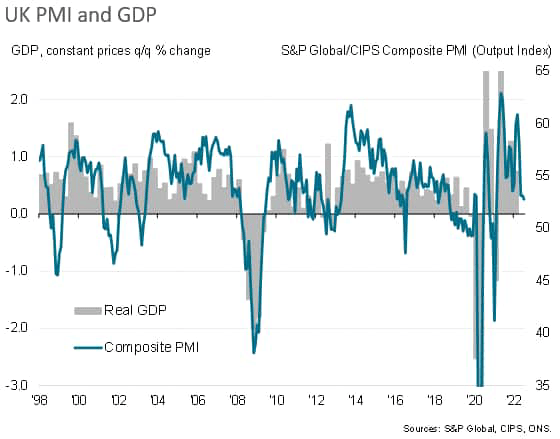

Industry data showed that service providers continued to outperform in July despite the latest expansion in production being the weakest in 17 months. Businesses reported that the resurgence in consumer demand for services has started to cool off since the pandemic lockdowns, partly due to rising living costs, while at the same time demand growth for industrial and other business services has moderated significantly in recent months amid growing concerns has on the economic prospects.
Meanwhile, manufacturing output fell for the first time since May 2020. Goods makers typically cited a lack of new work to replace completed orders, reflecting muted customer confidence and weaker global economic conditions.
New orders rose modestly in July, driven by a continued surge in new orders across the service economy – particularly consumer spending on travel and leisure services. Manufacturers, however, reported a further decline in sales volumes, the rate of which accelerated to a two-year high.
Measured overall, order intake growth was among the weakest during the pandemic, excluding the lockdown months, which in turn led to the first decline in backlogs since February 2021. Note that declining backlogs typically result in companies reassessing their operational capacity needs. This means downside risks for both output and employment over the coming months unless new orders pick up.
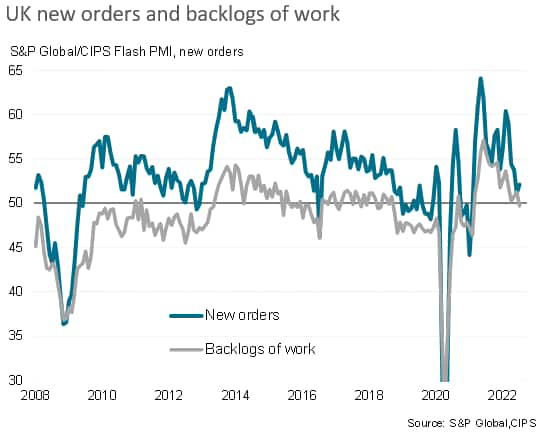
The near-term outlook for manufacturing looks particularly worrying as a lack of new orders coincides with a build-up of unsold inventories on weak consumer demand. This in turn indicates significantly weaker production growth in the coming months via the ratio of incoming orders to inventories of the survey. This ratio is now at one of its lowest levels since the global financial crisis.

Inflation cooling, for now
There was better news on inflation. Input cost inflation in both manufacturing and services weakened for the second straight month, with the seasonally adjusted index falling sharply to 78.3 in July, from 84.5 in June. This signaled the lowest rate of input cost inflation since September 2021. Manufacturers saw a particularly sharp moderation in cost pressures to their lowest level in 18 months. Respondents pointed out that lower commodity prices had started to ease the pressure on commodity costs (particularly metals), but service providers noted that strong wage pressures due to staff shortages and rising consumer price inflation had further increased their cost burden.
July data reflected the trend in input costs and pointed to a further slowdown in inflation-driven prices. The recent rise in duties was the least pronounced since January, reflecting some efforts to dampen price increases amid weaker consumer demand.
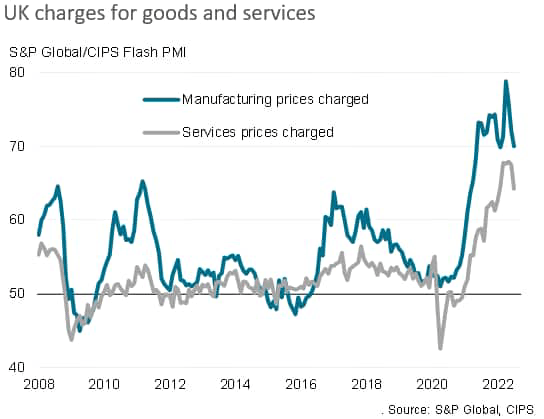
Looking ahead, the fall in PMI cost indicators bodes well to take some of the heat off inflation in the coming months. But the concern is that rising energy bills are likely to cause even more pain for UK households in the autumn.

Original post
Editor’s note: The summary points for this article were selected by Seeking Alpha editors.
Comments are closed.