


February 22, 2023 by Michael Maharey 0 0
Retail sales soared in January, giving the impression that the economy was booming. After all, it can’t be a problem if the consumers out there are consuming, right?
But many people ignore a key question: How are people paying for this shopping spree?
As it turns out, they’re putting a lot of that spending into credit cards.
Even with a sharp 1.8% decline in retail sales in December, revolving credit, which mostly reflects credit card debt, grew another $7.2 billion this month, up 7.3%.
To put the numbers in perspective, the annual increase in 2019 before the pandemic was 3.6%. It’s pretty clear that Americans still rely heavily on credit cards to make ends meet.
Meanwhile, household debt increased by $394 billion in the fourth quarter of 2022. This was the largest quarter-on-quarter increase in household debt in two decades. Debt levels are up $2.7 higher than when the pandemic started.
This is clearly not a sign of a healthy economy. Americans are spending more on everything thanks to runaway price inflation that doesn’t seem to be abating, and they rely on credit cards to do it. Savings collapsed. That’s not a solid economic foundation, and it’s not even sustainable. Credit cards have an awkward thing called a limit. And with credit card interest rates at record levels, people will hit those limits pretty quickly.
I stumbled across something the other day that provides an even more striking example of how dependent the US economy is on debt.
A company called Wisconsin Cheeseman sells gift packs of cheese, candy, and other goodies. And you can buy the gifts on their internal credit plan.
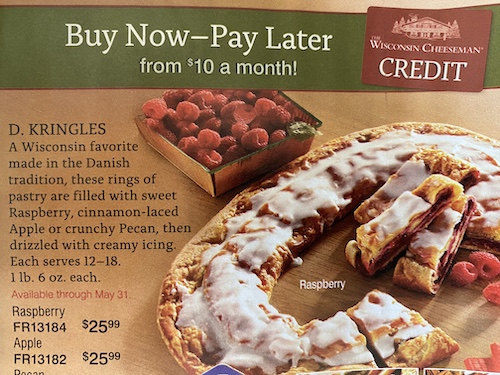
Let that sink in for a moment. A key benefit of a giftware company is that you can buy on credit.
Depending on the federal state, the effective annual interest rate ranges from a modest 5.75% to a proud 25.99%. (Most states are above 20% right now. But don’t worry. Your payments can be as high as $10 a month.) Just don’t think, you’ll probably be paying for that cheese for years to come.
There are other companies facilitating borrowing that don’t even show up in the official debt numbers.
Usage of BNLP services like Affirm, Afterpay and Klarna has exploded in recent years. These services allow consumers to pay for purchases by paying in installments, often with no interest. In a December 2021 report, Cardify CEO Derrick Fung said that “buy now, pay later” has quickly become mainstream.
“The consumer has become more compulsive over the past 12 months, and BNPL products are the result of us being locked in for too long and wanting more instant gratification,” he said.
Buy now, pay later is a convenient way to spread the spend, but there’s a dark side. It encourages consumers to spend more. Almost 46% of respondents said they would spend less if BNPL were not an option.
The surge in Buy now pay later (BNPL) is another sign of a deeply dysfunctional economy. Americans accumulate millions of dollars in additional debt on top of their credit cards with BNPL.
So while the mainstream pundits are telling you the economy is strong, they’re looking at a facade. It’s a house of cards. And eventually it will collapse.
American consumers are “propagating the economy” by spending today despite rising prices. But they borrow money for that. Tomorrow is fast approaching. And with it used up savings, higher interest rates and imminent credit card limits. This just isn’t a sustainable path, no matter how the mainstream press tries to spin it.

Get Peter Schiff’s top golden headlines delivered to your inbox each week – click here for a free subscription to his exclusive weekly email updates.
Call 1-888-GOLD-160 and speak to a precious metals specialist today!
Comments are closed.