
The US economy could face a “perfect storm” if Basel III Endgame comes into effect. Here's why


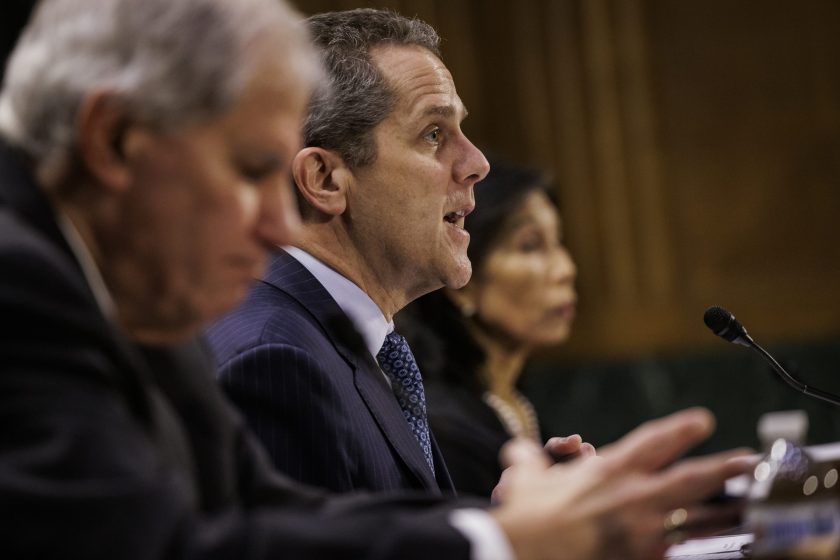
Michael Barr, vice chairman for supervision at the Federal Reserve, speaks with Martin Gruenberg, chairman of the Federal Deposit Insurance Corp., during a hearing of the Senate Banking, Housing and Urban Affairs Committee. (left), and Nellie Liang, undersecretary for domestic finance at the U.S. Treasury, right, on March 28. The investigation by congressional committees into the collapse of Silicon Valley Bank and Signature Bank heralded a conflict over the role of financial regulation in the second-largest bank failure in U.S. history. Samuel Corum – Bloomberg – Getty Images – Getty Images
The past three years of economic volatility have taken a heavy toll on many Americans and tested the resilience of households and businesses alike. During this period, the largest banks, fundamentally strengthened by a series of changes, served as a source of support by extending enormous amounts of credit, helping customers cope with uncertainty and stabilizing the entire banking sector at a critical moment. As the CEOs of these banks gather on Capitol Hill, Congress must ask whether the proposed capital rules threaten the essential work of these institutions.

The capital regulation plan, known as Basel III Endgame, will increase capital requirements for the eight largest U.S. banks by 20% or more. This is an exaggerated move considering that these banks' high-quality capital has tripled in the last 15 years. Higher capital requirements, as Federal Reserve Chairman Jerome Powell noted, increase the cost of credit and reduce access to it.
The plan will certainly increase the burden of higher interest rates post-pandemic, especially for those with lower incomes. Americans will have a harder time getting a loan, securing a mortgage or saving for retirement or a child's college education.
The impact is not limited to individual consumers. Small businesses relying on loans and farmers needing money for operations and equipment will struggle to raise much-needed capital.
A chorus of voices from left and right have spoken out against this proposed rule. Bipartisan consensus is rare these days, so the growing coalition of policymakers, advocacy groups and community leaders warning about the negative impact of stricter capital requirements should not be taken lightly. Sen. Mark Warner (D-Va.) has highlighted the potential compounding effect of stricter capital standards, high interest rates and disruptions in the commercial real estate market as a “perfect storm.” Sen. John Tester (D-Mont.) said he was concerned about the impact this would have on working Americans, saying he had “some concerns about the proposed changes and their impact on workers and households, small businesses and access on credit.” and the overall vibrancy of our capital markets.” In a letter to regulators, 39 Senate Republicans, led by Sen. Tim Scott (R-S.C.), emphasized the resilience of the well-capitalized U.S. banking system and argued the proposal would negatively impacting the economy and making credit more expensive and difficult for millions of Americans to obtain.
Given these concerns, the legitimate question arises as to why capital increases of this magnitude are necessary. But no one seems able to provide an answer. On the contrary: the prevailing official assessment of the banking sector and especially the largest banks is laudatory. In fact, every hypothetical loss the proposal seeks to address has occurred during real-world stress tests like the pandemic, and the largest U.S. banks have continued to support the economy within current capital requirements despite those losses.
Looking back on the years of reforms under the Dodd-Frank Act and Basel III, Chairman Powell highlighted improvements in the resilience of the banking system, stating: “The major banks in the United States are very strong, well capitalized, have plenty of liquidity and “I think it's been a source of strength for us over the last few events.”
The future path of the U.S. economy is far from certain, and hardworking Americans will pay a price as regulators impose new, unwarranted capital requirements. Policymakers must demand major changes to the Basel III endgame proposal so that the banking sector can continue its important role in the U.S. economy – and to avoid taxing consumers and businesses without meaningfully benefiting financial stability.
Kevin Fromer is President and CEO of the Financial Services Forum.
More must-see commentary from Fortune:
The opinions expressed in Fortune.com comments are solely the views of their authors and do not necessarily reflect the opinions and beliefs of Fortune.