


Douglas Rising/iStock via Getty Images
The backlash from the war in Ukraine has only just begun to rock the global economy, but early signs for the US remain encouraging. There is still a long way to go and it is too early to make confident forecasts, but preliminary data for March suggests that growth is still dominant.
Let’s start with yesterday’s PMI survey data that paints a bullish profile for the US macro trend this month. The US Composite Index’s first estimate, a survey-based proxy for GDP, accelerated to eight months in March. The 58.5 print is well above the neutral 50 level and signals a solid expansion trend.

“Manufacturers and service providers saw a stronger rebound, largely supported by pent-up demand from the easing of Covid-19 restrictions,” reports Markit Economics. “Firms also found that less severe supply disruptions and job creation enabled firms to increase production.”
The latest weekly US jobless claims update supports the bullish PMI data. In fact, jobless claims fell last week to their lowest level since 1969.
“US companies don’t lay off employees because they understand the tremendous challenges they face in filling vacancies,” said Ryan Sweet, senior economist at Moody’s Analytics.
A research note from economists at investment bank Jefferies indicates that the labor market is “extremely strong and [jobless claims] Data is just the kind of evidence that has given the Fed confidence that it can raise rates faster to fight inflation.” Overall, “Demand for labor is strong and there’s no reason to think it will will change in the foreseeable future barring another wave of a new Covid variant.”
Despite these optimistic figures, it is premature to assume that the economy has dodged a cyclical bullet. This evaluation or rejection will take several months. As CapitalSpectator.com pointed out earlier this week, the risk of a recession has increased recently, mainly due to the combination of rising inflation and various global shocks triggered by the war in Ukraine.
But the higher recession risk has not yet reached the tipping point. While the potential for trouble has certainly increased compared to a month ago, there’s still room for debate about what’s next. For now, using the numbers released so far shows a low probability that a new NBER-defined economic contraction has started or will start in the immediate future. The challenge is that economic conditions will undergo radical and perhaps dramatic changes in the coming weeks due to the backlash from the Russian invasion of Ukraine and elevated inflation.
An additional element of uncertainty, some economists advise, is changes in the forces of growth and contraction. “The long era of low inflation, suppressed volatility and easy financial conditions is coming to an end,” says Mark Carney, a former Bank of England governor. “It’s being replaced by more challenging macrodynamics, where supply shocks are just as important as demand shocks.”
Another complication is that the US economy is heading into a period of heightened macro risk at a slowing growth rate. Some recent nowcasts for Q1 GDP activity are projecting a sharp slowdown in manufacturing, suggesting that economic activity will come to a virtual standstill. The Atlanta Fed’s GDPNow model forecasts Q1 GDP to expand a modest 0.9% in the first three months of 2022 (based on March 24 estimate) — a dramatic slowdown from the blistering surge from 7.0% in Q4 (annualized rate).
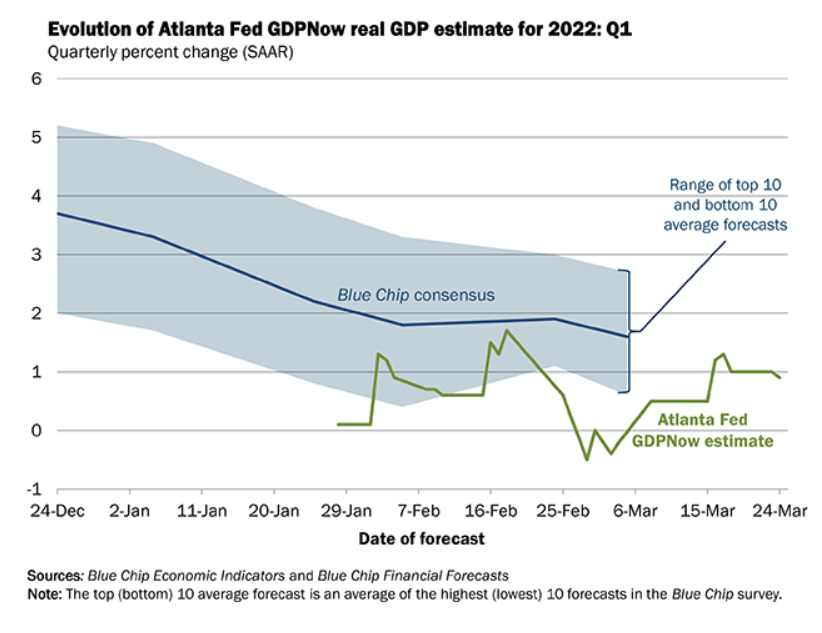
However, other nowcasting models suggest otherwise. Notably, Now-casting.com is currently estimating a much stronger US expansion north of 4.0% for the upcoming Q1 numbers based on the company’s March 25th analysis.

However, with a global shock just beginning to shake economies and uncertainty as to how the Ukraine war might play out over the coming days and weeks, a healthy dose of humility is needed to chart the course of US economic activity in the near term to estimate So far, however, there is reason to believe that the current expansion will continue to some extent for the foreseeable future. The challenge is to monitor the incoming data and decide how or whether to change the cautiously optimistic outlook.
Original post
Publisher’s Note: The summary bullet points for this article were selected by Seeking Alpha editors.
Comments are closed.