


This year’s Earth Overshoot Day fell on August 2nd. Since 2011, it has been held in the first few days of this month, which might give the impression that things have been more or less stable for the past 12 years. However, considering what the date means, the only relief would be that it was consistently later. How can we exhaust all of the planet’s natural resources in any given year by August? Circular economy principles could help us avoid that, but they would also break the legs of traditional industries, especially the automotive industry.
Stellantis recently attended the Motor & Equipment Manufacturers Association (MEMA) Sustainability Summit in Troy, Michigan. The company showcased its circular economy efforts with the SUSTAINera brand, which offers remanufactured parts for older cars. According to the car manufacturer, these products “offer savings of up to 80% in raw materials and 50% in non-emitted CO2 compared to equivalent new parts”. Stellantis also said that “remanufacturing accounts for 72% of circular economy business in North America, with recycling and repair accounting for 28%.” While that’s a valid effort, it falls far short of the mark.
Classic cartoons from the 1950s taught children how things should work: in the beginning there was someone willing to sell new products. The more they sold, the more money this entrepreneur would have to grow the business. Eventually, these goods would be exported, opening up new markets for the company. Some cartoons also discussed the capital market and how selling stocks could help grow the company. This is called the linear economic model for a reason: companies take (raw materials), make (their products), and sell them for people to use and eventually discard. The ultimate destination of these products is disposal (and the pollution caused by that process).
The circular economy preaches that products should last longer, which immediately undermines an incentive automakers have relied on for most of their careers: new designs and the urge for people to buy the latest product available. In order for the vehicles to last as long as possible, the planned obsolescence would have to be ended. In other words, we wouldn’t have new cars every six years or a mid-cycle refresh. Buying a new or used car would depend on rational motives as they would be very similar.
Photo: Earth Overshoot Day
What makes the idea circular is that these cars should be refurbished or recycled on site after they break down. What are the benefits of transporting waste for recycling? The closer a given product is to the place where it can be reused or transformed into new things, the lower the carbon footprint of the whole thing. These principles would be a huge problem for the current model pursued by the automotive industry and the idea of exporting vehicles.
Mass production began with Henry Ford in the USA, from where the vehicles were initially exported worldwide on a large scale. If a particular market had enough demand, a local plant would be built there. Europe liked the idea, followed by Japan, South Korea and, more recently, China. Other countries also export, but not thanks to local companies: foreign car manufacturers produce there and ship these products abroad. Export is a hedge in case the domestic market doesn’t do well. This is one of the reasons for car manufacturers to standardize their product range and try to sell the same products everywhere.
Just like factories, American junkyards followed the country’s lead and soon spread across the world. With a circular economy, they probably wouldn’t exist: the recycling work they do would be more thorough, and they would become something other than a landfill for old and discarded car bodies. All good parts would be separated immediately and stored somewhere. Components or body parts with no commercial value or in a condition that does not permit reuse are sent to recycling companies.
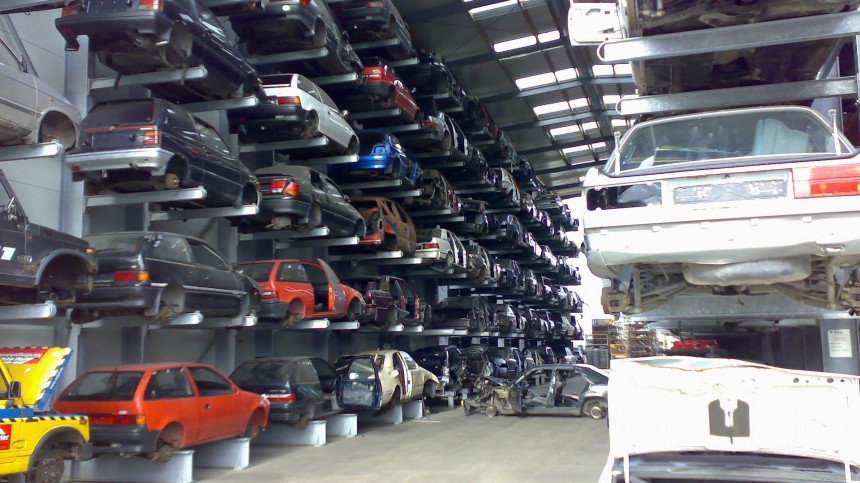
Photo: IFranz/Creative Commons
Now imagine one of our major car manufacturers that produces cars only for its local markets. If they wanted to sell vehicles in other countries, they would have to set up factories there that would also be responsible for recycling cars that could not be remanufactured. Exporting as many cars as possible would be neither a goal nor a relief in a circular economy. How would shipped vehicles be available locally for recycling? That would mean that the raw materials for making new cars or refurbishing existing cars would not be available. On the other hand, it would also help avoid the risks of transporting vehicles in ro-ro (roll-on/roll-off) cargo vessels, as recently demonstrated by the Fremantle Highway.
To be honest, local demand would be met quickly, which also poses another challenge for the current industrial model: Selling goods cannot be the only way to make a profit. Riversimple has already accommodated this by refusing to sell its cars: it will offer mobility services. In other words, customers pay to use the vehicles. From hydrogen refueling to insurance, everything is included in the monthly fee. Would any other car manufacturer follow the same idea? As of this writing and from what Stellantis has shared, that’s very unlikely. Most automakers want changes that will help keep things the way they are.
The earlier enthusiasm for cars is fading. Some activists even believe that we would be better off without them. Yet most people still value the freedom to get behind the wheel and go where they want or need to go. Circular economy principles allow us to maintain this without contributing as much to Earth Overshoot Day as the current model does. While this shift is inevitable, we wonder when the industry will realize this and who will take the lead. From what we’ve seen so far, the disruption won’t come from traditional players, which is a shame: they’ll go under and try to defend the way they do things until they can’t do them anymore.
Comments are closed.