


The circular economy model is a proposed solution to the climate catastrophe that has garnered widespread support from legislators and industry leaders alike. The industrial chemical sector supplies materials for 95% of all manufactured products and plays a key role in moving away from the unsustainable ‘take-make-waste’ production model that we have today.
Credit: General Photographer/Shutterstock.com
What is the circular economy?
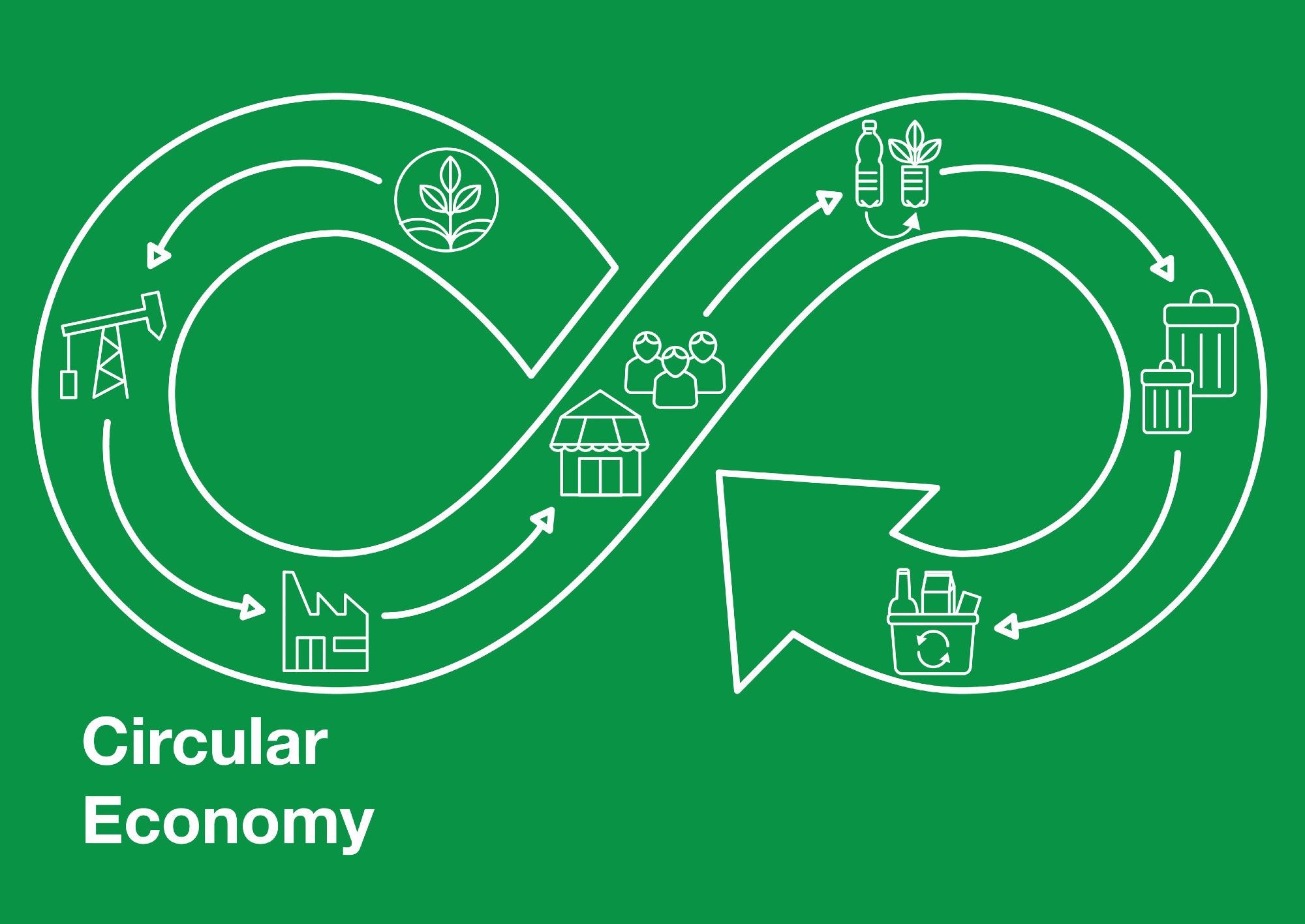
Proponents of the circular economy model describe today’s product system – the extraction of finite resources, their processing into materials and then consumer products, the distribution of the products, their consumption and disposal – as linear. This starts with the extraction and ends with the disposal and consumes a lot of energy in the process.
As an alternative to this “take-make-waste” system, government and industry leaders have started to move towards a circular economy. Here the “loop” of the linear system – product cycles that only go in one direction – is closed. Closed loop means that a material stays in use, is not wasted and equivalent new material is unnecessary.
The goal of a circular economy is to reduce or even eliminate our need for new materials. It does this by closing the loop in product cycles, by reusing items or recycling their materials at the end of their lifecycle, and by designing products from the outset to be used multiple times over a long period of time.
Closing cycles in the chemical industry
Leading companies in the chemical industry have responded to the challenge of the circular economy. The sector uses more alternative raw materials such as sequestered carbon and bio-based raw materials and increases the use of recycled material.
The sector also helps make materials and products more durable, extending their lifespan while reducing waste and the demand for new products.
The chemical sector also plays a role in all forms of recycling (mechanical, chemical and organic) and will be further integrated into the broader circular economy.
A promising new role for the chemical industry in the transition to a circular economy lies in the development of new bio-based chemical products that – unlike mineral alternatives – are not extracted resources but can be produced sustainably in terms of energy efficiency.
Credit: MG_vectors/Shutterstock.com
Using bacteria to recycle carbon waste for chemical products
A team of scientists from Illinois, Northwestern University in the US, and gas fermentation technology developer LanzaTech recently used a bacteria-based process to recycle waste carbon dioxide into useful industrial chemicals.
Their study, published in the journal Nature Biotechnology in 2022, demonstrated the ability of a strain of bacteria to recycle carbon dioxide into acetone and isopropanol (IPA) — two of the most commonly manufactured chemicals. The authors described a process to select, evolve, and optimize the bacterial strain to achieve this novel bacterial carbon-converting ability.
Read our interview with the researchers here: Converting carbon into key chemicals with bacteria
Acetone and IPA are typically made using fossil fuels, but this technique makes them redundant. It also removes greenhouse gases from the atmosphere with a critical gas fermentation step in the process. As a result, researchers found a potential 160% reduction in greenhouse gas emissions (replacing the emissions with carbon negativity, which accounts for 60% of their total weight) through a life cycle analysis.
As bulk and platform chemicals, acetone and IPA together have a global market of over $10 billion. IPA is the basic ingredient for one of the two World Health Organization-recommended disinfectant formulas that are highly effective in fighting the coronavirus. Acetone is a solvent used in the manufacture of many plastics, synthetic fibers, polyester resins, cleaning products, and cosmetics.
Researchers used a carbon-negative gas fermentation process to produce Clostridium autoethanogenum, an anaerobic strain of bacteria developed by LanzaTech. Then, using synthetic biology techniques, they reprogrammed the bacterium to ferment carbon dioxide and produce acetone and IPA as fermentation products.
To produce these chemicals in a more sustainable way, the researchers developed a new gas fermentation process. They started with Clostridium autoethanogenum, an anaerobic bacterium developed at LanzaTech. Then the researchers used synthetic biology tools to reprogram the bacterium to ferment CO2 to make acetone and IPA.
The team is confident that these reprogrammed strains of bacteria can be produced on an industrial scale using the carbon-negative gas fermentation process. This would result in less demand for fossil fuels without relying on reducing demand for disinfectants and solvents, as well as eliminating production sources of greenhouse gas emissions. The scientists also believe their approach could be applied to sustainably produce other useful industrial chemicals using bacteria.
References and further reading
Brudermüller, M. (2020). How will the chemical industry contribute to the circular economy? politico.eu. [Online] Available at: https://www.politico.eu/sponsored-content/how-will-the-chemical-industry-contribute-to-the-circular-economy/.
Liew, FE, R. Nogle, T. Abdalla, et al. (2022). CO2-negative production of acetone and isopropanol by gas fermentation on an industrial pilot scale. natural biotechnology. Available at: https://doi.org/10.1038/s41587-021-01195-w.
Northwest University (2022). Bacteria recycle carbon waste into valuable chemicals. Eurekalert. [Online] Available at: https://www.eurekalert.org/news-releases/943910.
Pilkington, B. (2022). Circular Economy and Electronics. AZO materials. [Online] Available at: https://www.azom.com/article.aspx?ArticleID=21336.
Disclaimer: The views expressed herein are those of the author, expressed in his own capacity and do not necessarily represent the views of AZoM.com Limited T/A AZoNetwork, the owner and operator of this site. This disclaimer is part of the terms of use of this website.
Comments are closed.