


Weak global demand for semiconductors, limited benefits from China’s reopening and further rate hikes mean Taiwan is in for a tough year.
Taiwan: At a Glance
Taiwan’s economy has shown signs of weakness since September 2022, when global demand for semiconductors collapsed. This was mainly due to high inflation and the resulting weaker demand for electronic items in the USA and Europe. Demand from China, which is also a large consumer market, also suffered from the Covid-19 measures. Average year-on-year growth for the first three quarters was over 3%. This is low compared to 7% in the same period last year. Inflation picked up but did not exceed 3.6% in 2022. The central bank nevertheless raised the discount rate from 1.125% to 1.75%. The Taiwan dollar weakened by around 10% against the US dollar in 2022.
GDP and inflation prospects
Source: CEIC, ING estimates
3 views for 2023
Weak semiconductor demand leads to slower growth
Taiwan’s economy will continue to be weighed down by shrinking semiconductor sales as external demand slows. Semiconductors account for around 40% of Taiwan’s exports. As purchasing power in the US and Europe continues to fall due to high inflation and the economy in mainland China has yet to fully recover, the challenging period for semiconductors and thus trade for Taiwan could continue until at least the first half of 2023. If External Demand Improves In the second half of the year, Taiwan’s economic growth should accelerate.
Taiwan may not benefit from the reopening of borders in mainland China
The removal of most of the Covid restrictions by mainland China and the reopening of borders may not benefit Taiwan, at least in the first half of 2023. Taiwan has banned tourists from mainland China since the Covid outbreak, only allowing Chinese citizens to visit for business or family reasons. This means that retail sales in Taiwan may not recover to pre-Covid levels in 2023.
Monetary policy will weigh on the economy
Taiwan’s central bank could continue to shadow the US Federal Reserve’s rate hike path, at least in the first quarter of 2023. This means that monetary policy will exacerbate weak economic growth. This is a risky policy that could put further financial pressure on businesses and households facing higher interest costs. On the fiscal side, the government may need to extend concessional policies to small and medium-sized businesses, and it will likely spend more on military spending. The New Taiwan Dollar (TWD) could be volatile if the central bank changes its interest rate path from hikes to cuts. Taking more time to transition from rate hikes to easing than the US Fed could help support TWD against the US dollar from Q2-Q4 2023.
Summary table for Taiwan forecasts
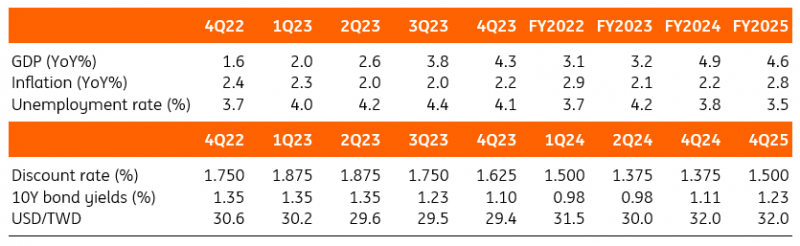
Source: CEIC, ING estimates
Read the original analysis: Taiwan’s economy under pressure due to ongoing trade problems
Comments are closed.