


georgeclerk/E+ via Getty Images
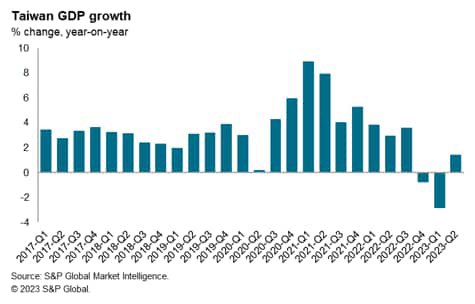
Taiwan emerged from the technical recession in the second quarter of 2023 with GDP growth of 1.7% qoq (q/q) after GDP contracted for two consecutive quarters. The rebound was fueled by private consumption, which grew 12.1% yoy in the second quarter from 2023.
However, the export sector continued to be hit by falling exports, which fell by 6.6% yoy in the second quarter of 2023. The net impact on GDP was mitigated by a sharp fall in imports, which fell 7.7% yoy. j.
A key factor behind the export slowdown was weak demand for Taiwan’s electronics exports in key global markets, particularly the US, EU and mainland China.
The most recent reading for the S&P Global Taiwan Manufacturing Purchasing Managers’ Index (PMI) was 44.1 in July, still suggesting conditions for Taiwan’s manufacturing sector will contract during the year second half of 2023.
Taiwan’s exports continue to decline
Taiwan’s economy recovered in the second quarter of 2023 and returned to growth after posting two consecutive quarters of negative growth.
As a result, Taiwan’s technical recession, which lasted from the fourth quarter of 2022 to the first quarter of 2023, ended in the second quarter of 2023, mainly driven by strong growth in private consumption.
Taiwan’s growth slowdown follows a period of strong economic growth in 2021 and 2022. In 2021, annual GDP grew 6.5 percent year-on-year. This was the fastest annual economic growth since 2010, driven by export growth of 29% yoy, with semiconductor exports up 27% yoy.

This was followed by continued positive GDP growth at a rate of 2.4% in calendar year 2022, supported by strong global demand for electronics exports throughout most of 2022.
Taiwan’s merchandise exports grew 7.4% yoy in 2022, buoyed by the strong expansion of electronic components exports, which rose 16.4% yoy, while semiconductor exports grew 18.4% yoy.
However, since mid-2022, Taiwan’s electronics sector exports, which are a major export item, have declined significantly due to falling electronics demand in the US, EU and Mainland China. The decline in Taiwan’s exports has been a key factor behind the country’s economic slowdown.
Taiwan’s exports remained weak in the first seven months of 2023, with goods exports falling 10.4% yoy in July 2023, after an even sharper 23.4% yoy decline in June. In the first seven months of 2023, Taiwan’s exports fell by 16.9% year-on-year.
Exports to mainland China and Hong Kong SAR fell 16.3% yoy in July after contracting 22.2% yoy in June. Mainland China and Hong Kong SAR remained the largest export market, accounting for 34.6% of Taiwan’s total exports in July.
In July, Taiwan’s exports to ASEAN fell 8.4% yoy, while exports to the US fell 3.3% yoy. Exports to Europe performed strongly, growing 24% year-on-year due to higher exports of ICT products.
Business conditions in Taiwan’s manufacturing sector remained weak in mid-2023. Industrial production fell 16.6% yoy in June, while manufacturing output fell 17.2% yoy.
At 44.1 in July, the S&P Global Taiwan Manufacturing PMI fell from 44.8 in June, signaling a 14th consecutive month of deterioration in the sector’s health.
The pace of the decline was the sharpest since November 2022 and one of the steepest since the survey began in April 2004.
A key factor dragging the headline index lower in July was an accelerating decline in manufacturing output. Production has now been scaled back for each of the past 16 months, with the latest drop being the fastest since January.

Total new business also fell at the strongest rate since January and overall rapidly. Panel members noted lower sales from both domestic and external customer bases.
Notably, new export business fell at its fastest pace in six months, with companies citing lower demand in a number of markets including Europe, Japan, mainland China and the US.
Weak demand and improved material availability led to a further decline in average input costs in July. Input prices fell at a solid pace, the second-strongest since May 2020. Notably, selling prices fell at the fastest pace in just over three years.
Taiwan’s CPI inflation rate fell to 1.9% yoy in July 2023, while the core CPI excluding energy and food rose 2.7% yoy, suggesting that retail inflationary pressures remain contained.
Although inflation has moderated in recent months, on March 23, 2023, the Taiwanese central bank raised interest rates by 12.5 basis points (bps) to limit possible further inflationary pressures, after beginning 2022 with a series of modest tightening measures preemptively had acted on measures to curb inflationary pressures.
The central bank began its tightening cycle in March 2022, with its 25 basis point tightening move being the first rate hike since June 2011. The last change in policy rates was a rate cut in March 2020 in response to the global COVID-19 crisis. 19 pandemic.
The March 2022 interest rate hike was followed by a 12.5 basis point increase in June 2022, a 12.5 basis point increase in September 2022 and a further 12.5 basis point increase in December 2022.
Global headwind for the electronics industry
In July 2023, Taiwan’s exports of electronic products fell by 7.9% year-on-year. Despite the significant drop, July saw a less steep fall than June, when exports fell 21.3% yoy.
The decline in Taiwan’s ICT exports reflects the slowdown in the global electronics industry since mid-2022. The seasonally adjusted composite PMI for the electronics industry was 47.6 in July, signaling the fifth straight month of a continued decline in operating conditions across the global electronics manufacturing sector.
A sharp decline in the backlog contributed to the sharpest drop in production since June 2020. While demand conditions were subdued, companies took the opportunity to settle outstanding work as backlogs had fallen at the fastest rate since May 2020.
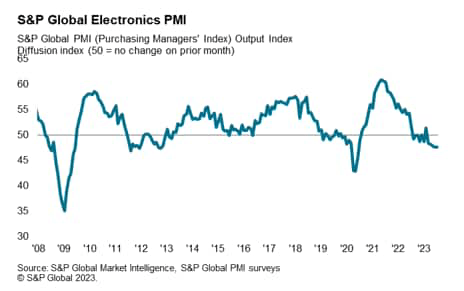
At the same time, electronic goods makers signaled an acceleration in input price pressures for the first time since last September, with the latest bout of input price inflation being the strongest in three months.

Global electronics manufacturers saw a sustained decline in production early in the third quarter of the year. The downturn was sharp and the strongest since June 2020.
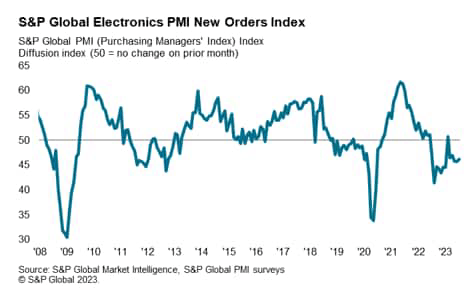
Orders at global electronics manufacturers fell for the fifth straight month in July. The new orders index continued to reflect contractionary conditions, reading below 50 and was often attributed by panellists to weak demand in the US, Europe and China amid broader economic weakness and market uncertainty.
Economic Outlook
After rapid economic growth in 2021 and continued strong expansion in 2022, Taiwan’s economy has weakened in 2023, mainly due to the decline in exports.
This reflects continued weakness in key markets for Taiwan’s electronics exports, particularly the US, EU and Mainland China. Taiwan’s export orders fell by 24.9% yoy in June 2023, indicating continued near-term weakness for the manufacturing export sector.
Taiwan’s medium-term prospects remain for continued positive expansion at a moderate pace, supported by rising global electronics demand in 2024 and 2025.
The impact of the COVID-19 pandemic has accelerated the pace of digital transformation due to the global shift to remote work, which has increased demand for electronic devices such as computers, printers and mobile phones.
The medium-term outlook for electronics demand is underpinned by key technological developments, including the rollout of 5G over the next five years, which will boost demand for 5G handsets.
In the medium term, the demand for industrial electronics is also expected to grow strongly, supported by Industry 4.0 as industrial automation and the Internet of Things rapidly fuel the growth of demand for industrial electronics.
Taiwan’s electronics industry will continue to benefit from its leadership in the production of advanced semiconductors, as well as the production of a wide range of other consumer and industrial electronics products.
Original post
Editor’s note: The summary bullet points for this article were selected by Seeking Alpha editors.
Comments are closed.