


Sweden, like the rest of Europe, is facing a recession. Given its history of unfortunate fiscal adventures, we have reason to worry that the incumbent administration will make a poor macroeconomic experience worse.
A year ago I wrote an economic obituary about the Swedish economy:
Three decades of debilitating fiscal policies deliberately aimed at bloating one of the world's largest and most unsustainable welfare states are about to boomerang to those who created those policies. This new crisis could well eclipse the crisis of the early 1990s.
This new crisis is now approaching. The latest labor force figures from Statistics Sweden show a decline in the number of Swedes who have jobs and a worrying rise in unemployment. Figure 1 compares unemployment rates for 2022 (gray) and 2023 (red); While 2023 started lower than 2022, things aren't looking good at all in the last three months:
illustration 1
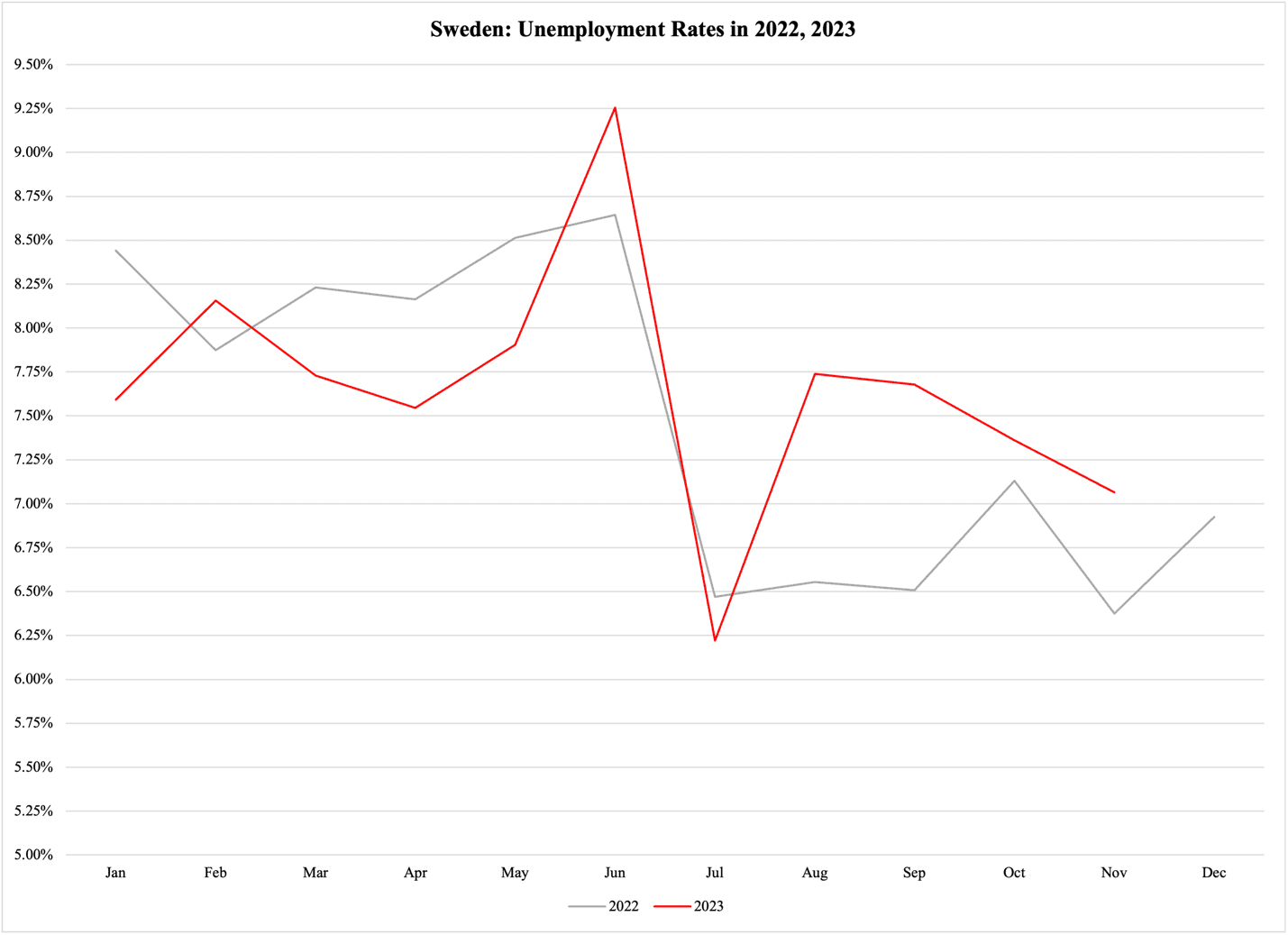 Source of raw data: Statistics Sweden. Calculations are based on the 15 to 74 age group – a demographic peculiarity in Swedish labor market statistics.
The rise in unemployment is now being followed by bad news on the tax front. Statistics Sweden again:
The overall local income tax rate will increase on average next year… Looking across the country, the tax increase is the largest in nine years.
Local income taxes in Sweden consist of two parts (hence the “total” comment above):
- A municipal part that feeds the general fund of city and municipal governments; this part constitutes two-thirds of the “total local income tax”;
- A regional part devoted almost exclusively to financing health care.
By 2024, Swedes will pay 32.4% of their taxable income in local income tax. That is 0.5 percentage points more than in 2014; Much of the increase over the past decade occurred before 2021.
The new increases in local income taxes are by no means drastic. With an average increase of 0.13 percentage points, this increase in tax rates will not have any significant negative economic consequences. But that doesn't mean they will go unnoticed: it's still a tax increase. It's important to remember that for low earners, every fraction of a dollar, euro or krona counts, especially when there is a tax increase that erodes their purchasing power.
The biggest problem with increasing local income taxes is that they can easily become part of a pattern of increasing taxes. So far there is no sign that Prime Minister Ulf Kristersson and his center-right coalition are planning tax increases. On the contrary, all other things being equal, I would expect Kristersson to oppose higher taxes.
However, the Swedish government has a history of using tax increases to fill gaps in its budget, even when the economy is in recession. The risks associated with such austerity-driven policies are significantly higher today as Sweden still struggles with elevated inflation:
Figure 2
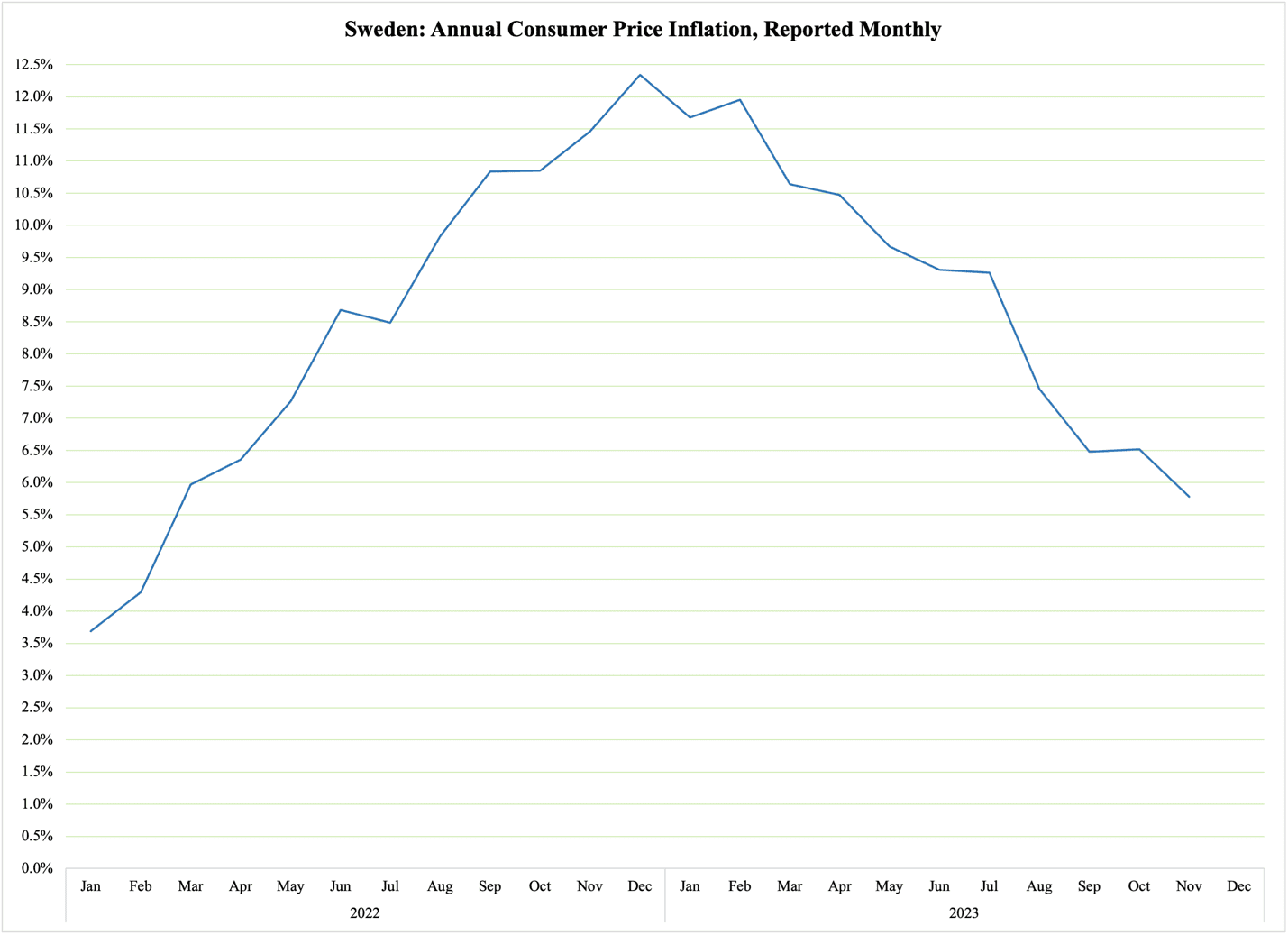 Source: Statistics Sweden
Figure 3 shows how taxes have influenced consumer price inflation in the past. Blue bars indicate additional inflation attributable to taxes. accordingly, red bars indicate the decline in inflation due to lower taxes.
Of the five episodes highlighted in Figure 3, three are of particular interest here:
Figure 3
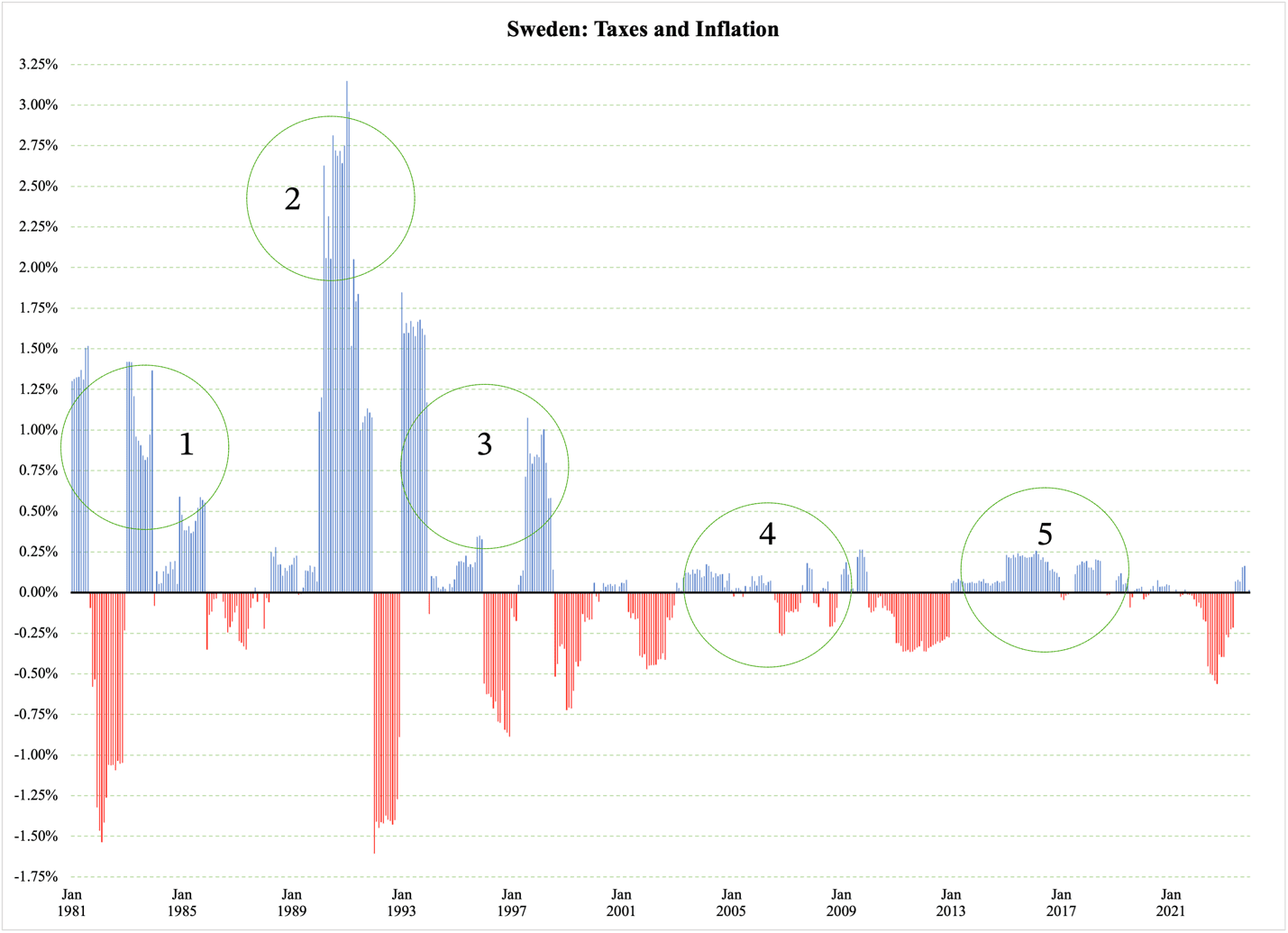 Source of raw data: Statistics Sweden
In episodes 1, 3, and 5, the Swedish government increased taxes to balance its budget. These tax increases consistently led to higher inflation; In the first two cases—the stagflation period of the early 1980s and the austerity period of the 1990s—higher taxes increased inflation by a full percentage point or more.
A percentage point higher inflation may not seem like that much, but think of it this way:
- In the first year, a person receives a 4% wage increase and inflation is 4%; he can now maintain his standard of living and support his family as before the wage increase;
- In the second year, his wages increase again by 4%, but thanks to higher taxes, the inflation rate rises to 5%; he is now forced to make small reductions in the cost of living, e.g. B. limit the quality of the food they buy;
- In the third year, he still gets a 4% raise, but taxes have now pushed inflation to 6.5%.
This is exactly what happened in Episode 2 in Figure 3. A very unintelligent tax reform nearly doubled the VAT base. The inflation effect was a temporary but economically painful increase in inflation; Tax increases accounted for more than a quarter of inflation in 1990 and a fifth of inflation in 1991.
It is important to remember that not all inflationary effects of taxes are the result of conscious fiscal policy. Episode 4 in Figure 3 shows a cyclical pattern in which taxes occasionally add a small margin to consumer price increases and occasionally reduce consumer price inflation. This episode, which coincides with the takeover of a Social Democratic government by a center-right coalition under Prime Minister Reinfeldt in 2006, is “normal” in the sense that it is largely free of political intervention in the pursuit of a balanced budget.
The non-political fluctuations in tax-related inflation do not only occur in Sweden. They exist in any economy with a complex, “modern” tax system, especially those that place great emphasis on taxing consumer spending through a VAT and excise taxes with similarly inflationary effects.
Here too, there are no signs that Prime Minister Ulf Kristersson will undertake a tax increase. At the same time, Kristersson has yet to deal with the severity of a fiscal crisis in a turbulent recession. When he gets there, it remains to be seen whether the Prime Minister can avoid repeating the catastrophic mistakes of the austerity measures of the 1990s, which I analyzed in detail in Chapter 5 of Industrial Poverty (see pp. 173-179).
Comments are closed.