


The effective overnight rate for interbank lending is now 3.08%. A little over six months ago it was 0%. According to the Fed’s current plans, the Fed Funds Rate (FFR) is heading towards at least 4% by the end of this year; and maybe even 4.5-5% by early 2023. Will that cause a problem you ask? Well, rising interest rates have already caused stocks, bonds, gold, crypto – and just about everything else – to crash. Even the commodities sector, which performed well in the first half of this year, has fallen sharply. In fact, virtually nothing worked on the long side except cash and the USD. Unfortunately for most, the carnage is not over and the pace of decline will only increase. Here’s why that should be the case.
The previous cyclical high for the FFR was 2.5%. It happened back in December 2018. Powell and company are now threatening to nearly double the same lending rate that shut down the economy four years ago.
Likewise, the cyclical high for the benchmark US Treasury yield was 3.22% in November 2018. At the moment it is 3.8%. 2.5% FFR and 3.22% 10-year notes were the rates that proved simply too high for the economy and markets in 2018. The debt load at the time was simply too onerous to withstand these higher borrowing costs. In addition, asset prices were so stretched that competition from fixed income prompted investors to dump riskier stocks and flee to the relative safety of government bonds.
In fact, the level of borrowing costs required to break the economy has fallen over time, just as the level of economic fragility has increased. It took an FFR of 6.5% to burst the NASDAQ bubble in 2000. It was a slightly lower FFR of 5.25% that burst the 2006 real estate bubble. In 2018, FFR increased over the year to just 2.5% over 3 years; but that was all it took to rock the economy and markets.
Facts show that economic conditions in 2018 put the company in a much better position to deal with rising borrowing costs than we see today. What is utterly ridiculous is that the Fed has the audacity to pontificate about a soft landing for the economy in this current cycle of monetary tightening; although the economic scenario is much worse than four years ago. And, of course, Wall Street is keen to propagate the Fed’s soft-landing myth.
Let’s take a closer look at the debt burden, asset price levels and GDP growth in 2018 and compare these data to today’s situation.
GDP growth in 2018 showed a fairly healthy 2.9% for the full year. Economic growth so far in 2022 is at SAAR of -1.6% for Q1, -0.6% for Q2 and consensus estimates for Q3 are below 1%. Essentially, the economy is much weaker today than it was in 2018.
Despite the carnage we’ve seen in the stock market so far this year, the valuation of stocks relative to the underlying economy is still higher today than it was four years ago. TMC/GDP was 123% at the end of 2018, today it is 145%.
We often hear that American consumers and businesses are in much better shape because of the scale of debt reduction that has skyrocketed. Therefore, they claim, it’s just a much better environment for the economy to tolerate these rising interest rates.
However, total US debt-to-GDP ratio was 775% in 2018. In 2022 it has risen to 810% and is currently extremely high compared to historical levels.
US Total Debt/GPD

But not only the national debt has exploded. Household debt was $15.6 trillion at the end of 2018. Since then, it has increased by over $3 trillion. While it’s true that household debt as a percentage of GDP is below its highest level since the Great Recession of 2008, that ratio is still higher than it was in 2018. And it’s far higher than it was before the Fed’s massive interest in rate-cutting regimes from the year 2000.
Ratio of household debt to GDP
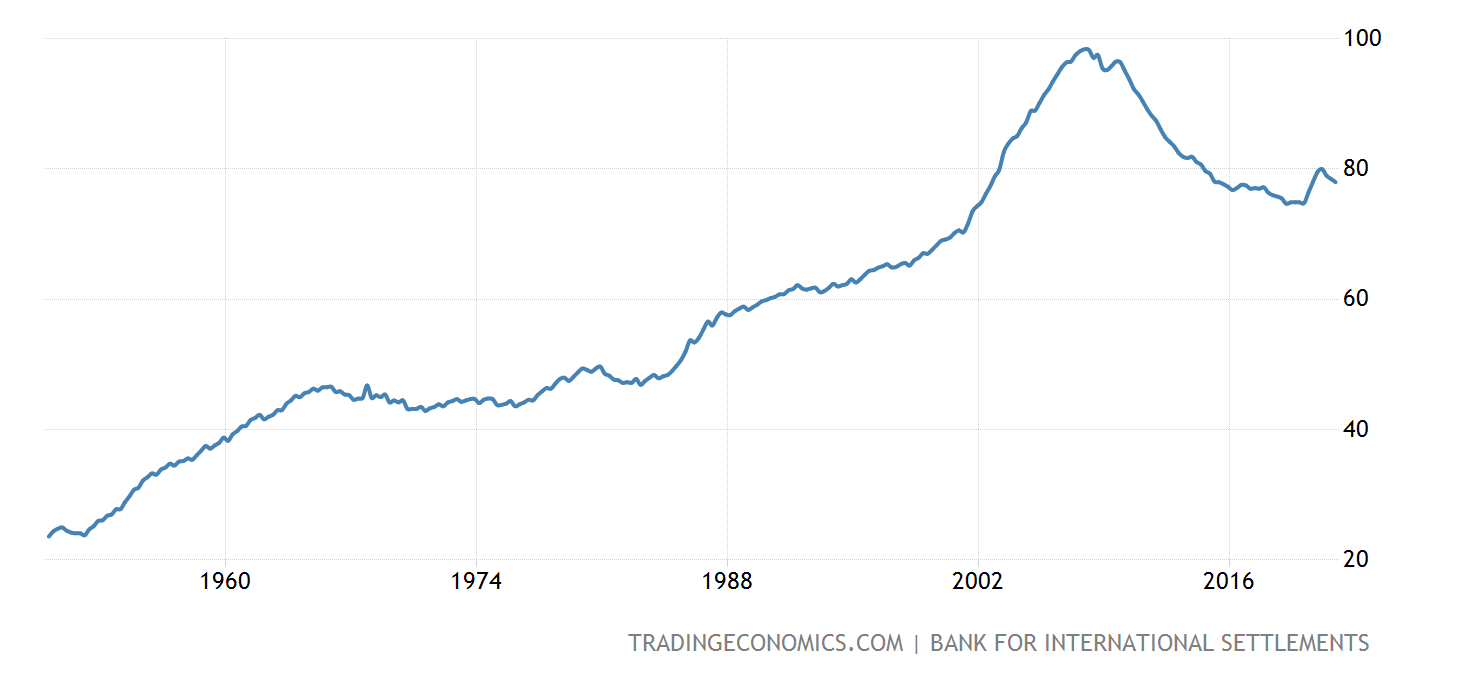
Corporate debt to GDP ratio is higher than at any time in pre-COVID pandemic history. The debt-to-GDP ratio of non-financial corporate corporations was 45% in 2018. As of Q2 2022, this ratio is over 50%. For historical reference, this ratio peaked at 45% at the peak of the NASDAQ bubble in 2000 and also during the housing bubble/Great Recession in 2008.

There is simply no evidence that the economy has undergone any deleveraging at all since 2018. In fact, nominal debt has skyrocketed. Most importantly, this debt is extremely high even when measured as a percentage of the QE and ZIRP-juiced economy. Therefore, there is no reason to believe that neither the public nor the private sector will be able to withstand the onslaught of rising borrowing costs and money destruction that is now taking place.
The only other time in history that the Fed hiked FFR and was in the act of QT was in 2018. The market went into freefall; until Powell promised to stop raising interest rates.
Today we find that the FFR is more than 50 basis points higher than 2018 and is rapidly heading much higher. In addition, the benchmark 10-year note yield is also about 50 basis points higher than the cycle high of four years ago. The other significant difference between 2018 and 2022 is inflation. It was just a lot easier for the Fed to bail out asset prices and the economy when inflation was below 2% — it was just 1.9% at the end of 2018. However, when the CPI is near a 40-year high, such a pivot becomes unsustainable.
Higher interest rates offered by US Treasuries offer a great alternative to stocks. And higher borrowing costs for companies also destroy margins and revenue for those companies. The sharp drop in consumer demand due to a weakening economy is adding to the pressure. Add in a skyrocketing USD and chances are that not only will corporate earnings fall well short of Wall Street’s forecast growth of 8% for 2023; but will end up posting a negative number instead.
Ironically, most of the economic data hasn’t been alarming — at least for now. Except for GDP, which Wall Street claims is just a passing quirk in the data. Just ask any perennial bull and they will tell you that jobs, consumers and corporate earnings are still very strong and able to withstand this hawkish Fed. However, the truth is that the economy and markets have never been so vulnerable. Therefore, the coming economic and earnings recession should be deeply acute.
Comments are closed.