


The Government Accountability Office's (GAO) latest report on the nation's financial health echoes the Congressional Budget Office's (CBO) analysis and warns that the national debt is on an unsustainable path. The report outlines the drivers of the country's fiscal performance and calls on Congress to develop a plan to address this outlook.
According to GAO forecasts, public debt would more than double over the next 30 years – from about 97 percent of gross domestic product (GDP) at the end of fiscal year 2023 to 229 percent in 2054. These forecasts assume that current policies persist into the next decade and include some simplifying assumptions about the relationships of different household categories relative to the size of the economy over the following two decades.
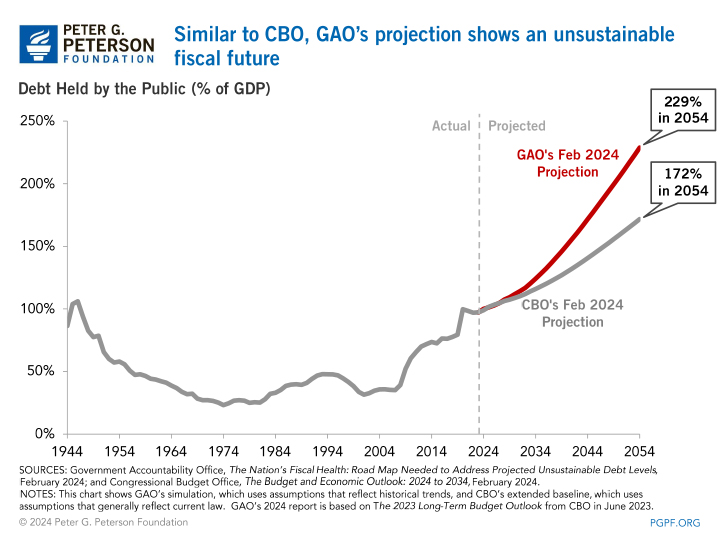
Although GAO's forecasts are based on CBO estimates released last year, their findings are similar to CBO's recent reports, which focus on the structural factors that cause imbalances between spending and revenue:
- Growth in spending. The GAO report highlights that future federal spending will be determined by increases in health care programs, Social Security and net interest rates. Each of these spending categories is projected to grow faster than the economy over the next 30 years. By 2052, the GAO estimates that federal spending on health care and Social Security combined will be 13.9 percent of GDP, up from 10.6 percent in 2023. Much of this increase is due to the aging population and rapidly rising health care costs attributed. In the long term, the net interest rate will rise significantly and reach a historic high of 3.2 percent of GDP by 2030 and 7.9 percent of GDP by 2052 – and due to increasing debt it will become the largest “program” in the federal budget within the next 30 years and higher interest rates.
- Insufficient income. For projections through 2033, GAO adjusts CBO's baselines to reflect the expectation that currently expiring tax provisions will be extended, reducing revenues to the federal treasury and increasing the deficit. These provisions include the individual income tax provisions that were part of the Tax Cuts and Jobs Act (TCJA) and are scheduled to expire at the end of 2025. Under these assumptions, GAO concludes that revenues would average 17.0 percent of GDP over the 2024-2033 period. In 2034, the GAO simplistically assumes that revenues will remain constant at 17.4 percent of GDP, their 50-year historical average, through 2097.
In the report, GAO also reiterates its opinion that Congress should develop an effective fiscal plan to address unsustainable fiscal trends, noting that four bills have been introduced in Congress in 2023 or 2024 to establish a bipartisan Finance Commission. GAO believes that an effective plan to address fiscal developments would include:
- Create fiscal rules and goals to manage debt.
- Consider alternative approaches to the current debt limit.
- Evaluate all drivers of debt.
- Close the Social Security and Medicare funding gaps.
- Take other opportunities to improve fiscal responsibility through good government efforts.
GAO's findings add to a body of nonpartisan evidence and analysis showing that actions to improve our fiscal outlook are needed so the country can meet future challenges, invest in the next generation, and build a strong and inclusive economy.
Related: 8 Startling Facts About the U.S. Financial Outlook
Photo credit: www.gao.gov
Comments are closed.