


Economic update Mexico
October 6, 2022
| Economic Report September 2022 | |||
| GDP, real April–June 22 |
employment, formal Aug ’22 |
CPI Aug ’22 |
weight/dollar Sep ’22 |
| 4.1% q/q | 66,500 jobs m/m | 8.7% YoY | 20.1 |
Mexico’s proxy for monthly GDP averaged 0.2 percent in July and August, a slight improvement from the previous two months. However, the possibility of a US recession, inflationary pressures, weak investment and monetary tightening are headwinds for the Mexican economy. The consensus forecast for 2022 (Q4/Q4) GDP growth prepared by the Banco de México fell to 1.8 percent in August (Table 1).
Table 1: Consensus Forecasts for 2022 Mexico Growth, Inflation and Exchange Rate
| July | August | ||
| Real GDP growth (Q4/Q4) |
2.0 |
1.8 |
|
| Real GDP (average year/year) |
1.8 |
1.9 |
|
| CPI (Dec ’22/Dec ’21) |
7.8 |
8.1 |
|
| Exchange rate – pesos/dollars (end of the year) |
20.8 |
20.7 |
|
| NOTE: CPI refers to the consumer price index. The survey period was the 16th-30th August. The next quarterly GDP data will be available on October 30th. SOURCE: Survey on the Expectations of Specialists in the Economy of the Private Sector: August 2022 (Communiqué on Economic Expectations, Banco de México, August 2022). |
|||
The latest available data show growth in industrial production, retail sales, remittances and employment, while exports fell. In August and September, the peso appreciated somewhat against the dollar and inflation remained high.
Economic activity improves
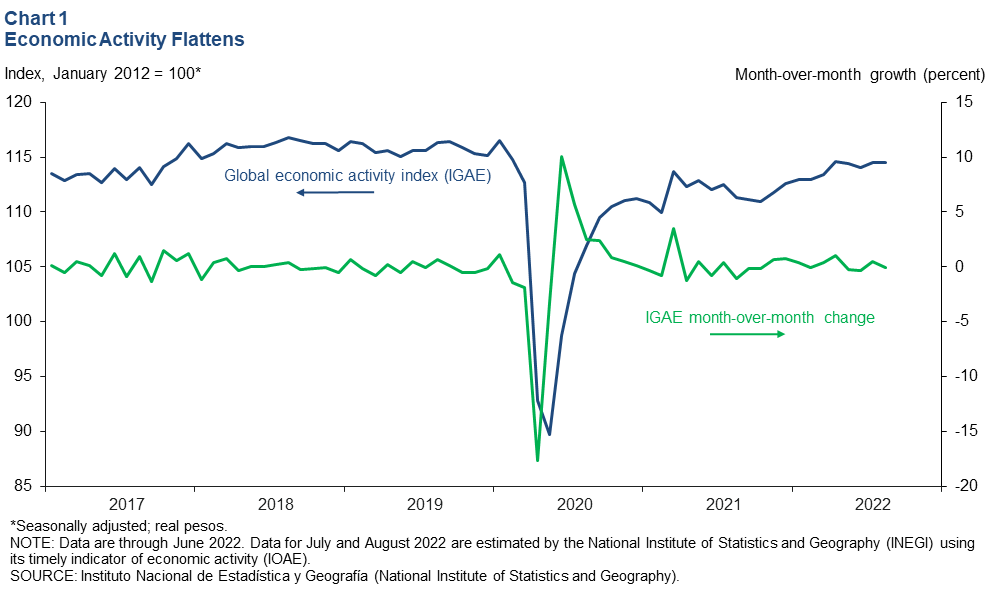
The Global Economic Activity Index (IGAE) — the monthly proxy for GDP growth — grew 0.2 percent month-on-month on average in July and August, a slight acceleration from the 0.3 percent average decline in the previous two months (chart 1). The pick-up in activity was mainly due to the manufacturing sector (including manufacturing, construction and utilities), which rose 0.2 percent compared to July and August. Growth in service-related activities (including trade and transport) was flat over the same period. Year-on-year, IGAE rose 3.0 percent in August and 2.2 percent in July.
Industrial production picks up
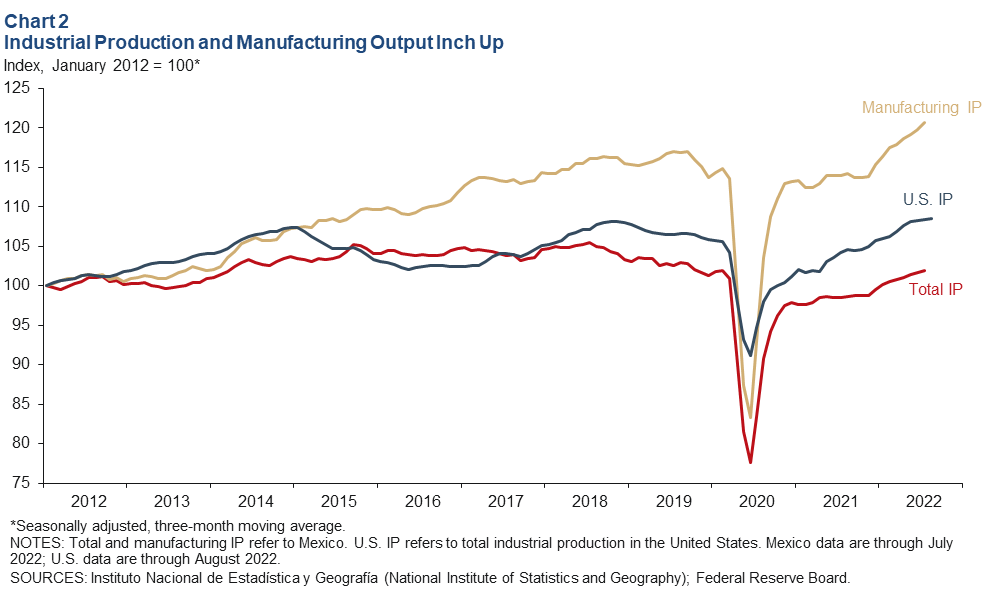
The three-month moving average of Mexico’s industrial production index (IP) – which includes manufacturing, construction, oil and gas exploration and utilities – rose 0.2 percent in July from June (Chart 2). On a monthly basis and on an unsmoothed basis, IP rose 0.4 percent in July, while manufacturing IP rose 1.6 percent. North of the border, US IP fell 0.2 percent in August after rising 0.5 percent in July. The correlation between intellectual property in Mexico and the US has increased significantly since the early 1990s with the rise in intra-industry trade between the two countries. Manufacturing in Mexico could experience a slowdown towards the end of the year, particularly if US consumer demand softens as a result of high inflation and higher interest rates.
decline in total exports
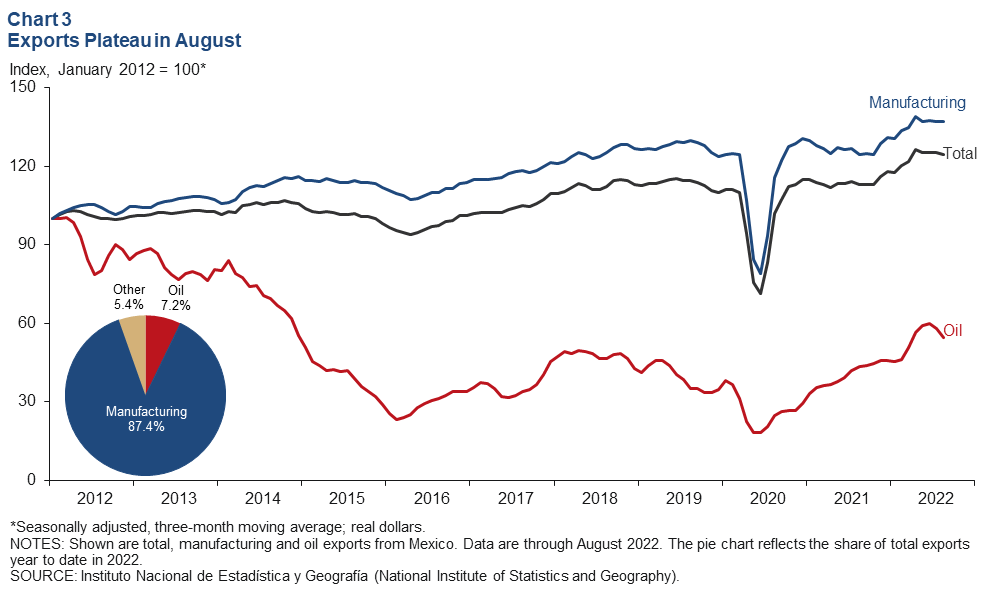
The three-month moving average of total Mexican exports fell 0.5 percent in August as oil exports fell and the much larger manufacturing export category was flat in part on weaker global demand (Chart 3). On a monthly basis and on an unsmoothed basis, total exports fell 1.0 percent in August, with oil exports falling 14.9 percent and manufacturing exports rising 0.8 percent. The rise in oil prices helped fuel oil exports growth earlier in the year, but oil exports are now declining as prices fall.
Retail sales continue to rise
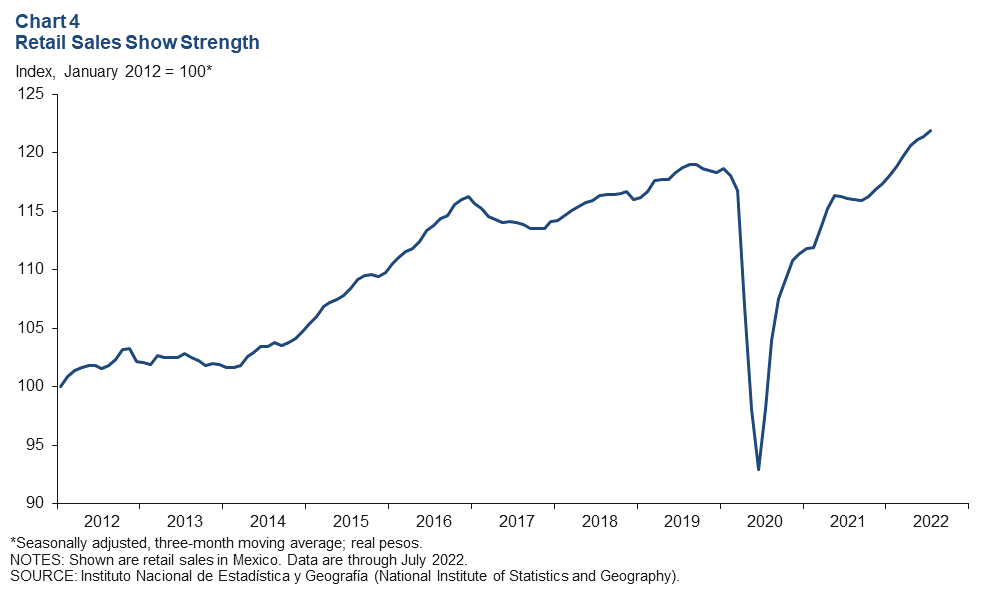
Mexico’s real retail sales index rose 0.4 percent month-on-month based on a three-month moving average through July (Chart 4). On a monthly basis and on an unsmoothed basis, retail sales also rose 0.9 percent in July. Retail sales reached pre-pandemic levels in October 2021 (February 2020). Recent strong growth in remittance flows may contribute to continued retail sales growth despite high inflation.
Wage growth picks up
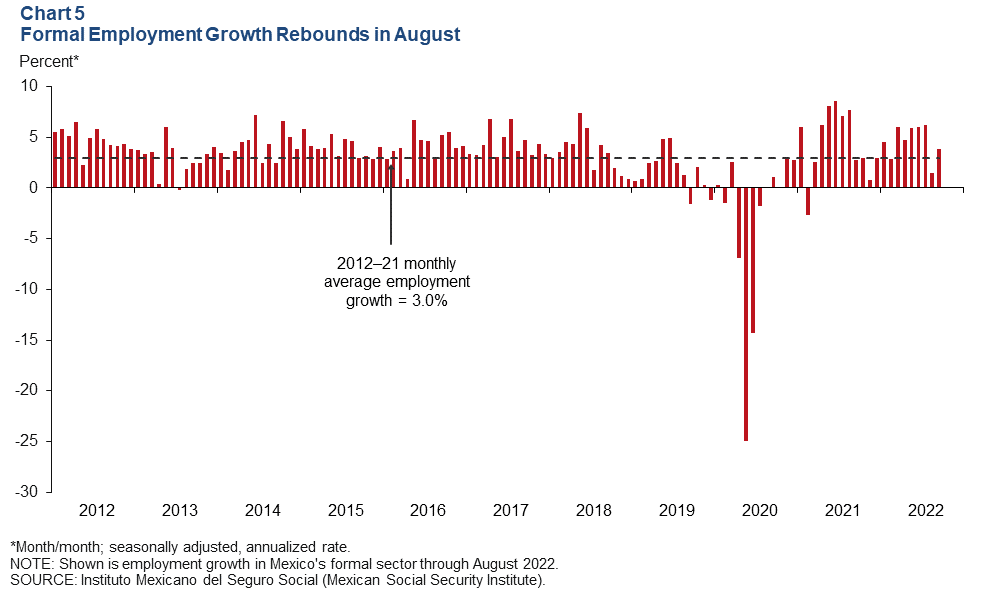
Formal sector employment – jobs on benefits and pensions – grew an annualized 3.8 percent (66,500 jobs) in August, after rising 1.5 percent in July (Chart 5). Year-on-year employment growth was 8.5 percent in August. Total employment, which represents 57.4 million workers and includes jobs in the informal sector, rose 3.9 percent in June from a year earlier. The unemployment rate was 3.2 percent in July, down from 3.3 percent in June. Employment in Mexico recovered to pre-pandemic levels in September 2021, while GDP in the second quarter of 2022 just reached pre-pandemic levels.
Peso gains slightly against the dollar
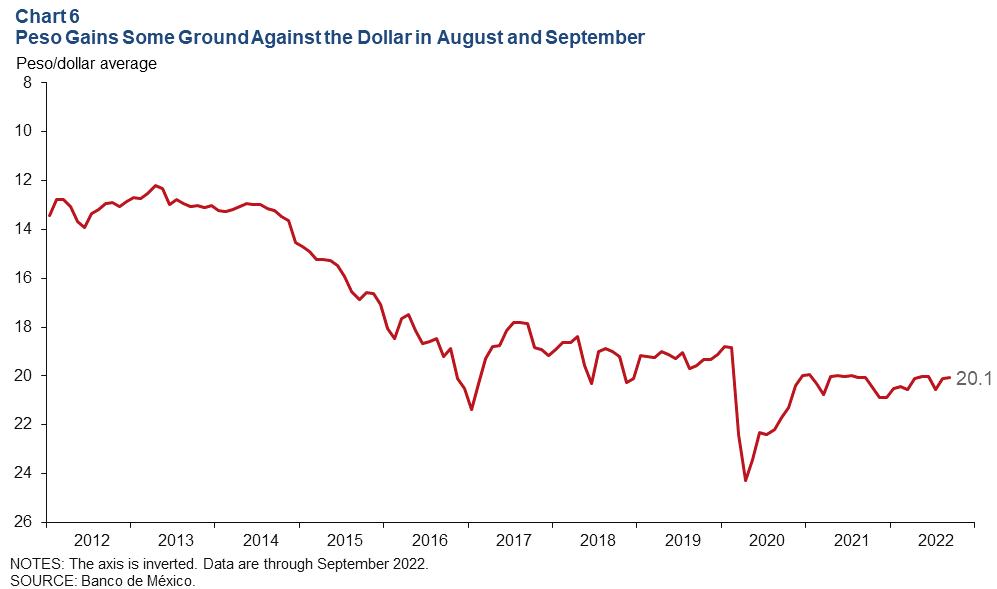
The Mexican currency averaged 20.1 pesos per dollar in September, in line with August levels but up from 20.5 in July (Chart 6). However, the peso is still 6.3 percent below its pre-pandemic level in February 2020. The peso has been under pressure due to high inflation and increasing uncertainty about domestic and global growth.
Remittances to Mexico are increasing
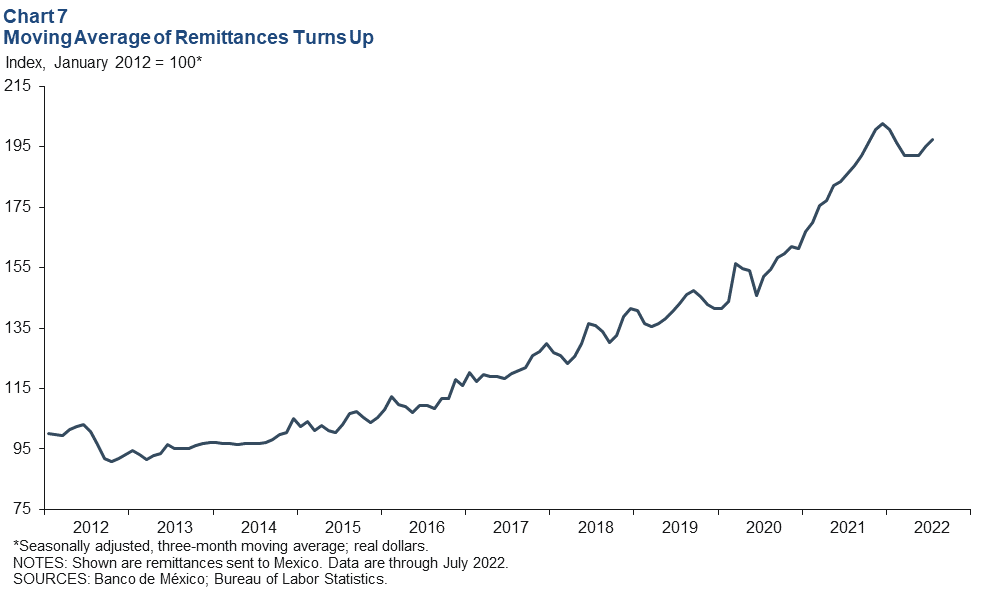
The three-month moving average of real remittances to Mexico rose 1.2 percent in July, after rising 1.5 percent in June (Chart 7). Month-on-month and unsmoothed, remittances rose 2.8 percent in July. Most likely, remittance flows to Mexico slowed in early 2022 due to high inflation in the US and elsewhere, which is eroding disposable income, including funds for remittances. However, remittances to Mexico recovered in May and have risen for three straight months.
The share of foreign-owned government debt continues to fall
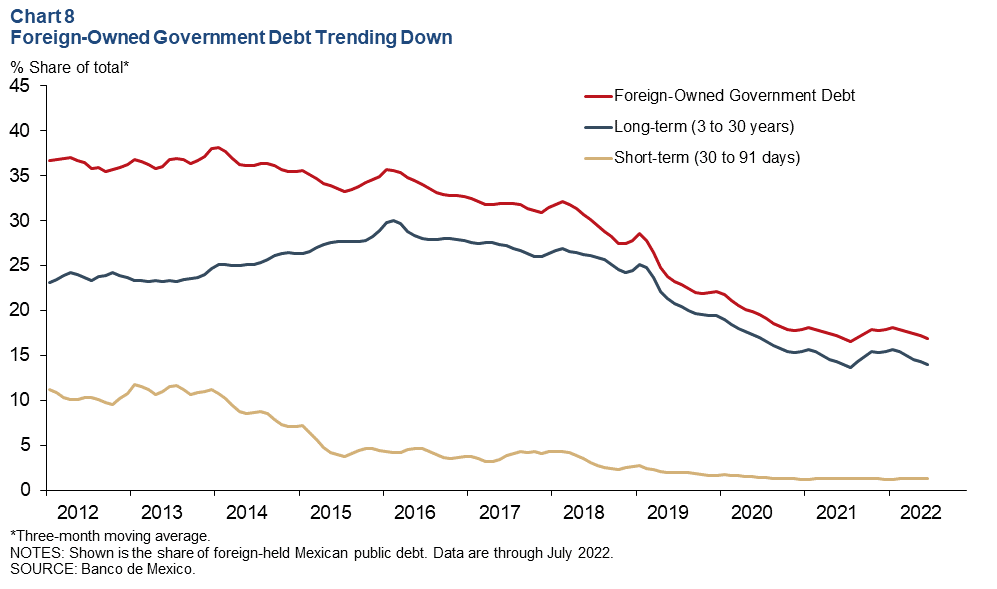
The three-month moving average of foreign-owned Mexican government bonds declined to 16.8 percent in July, down 0.4 percentage point from its June level (Chart 8). The decrease is due to a reduction in foreign ownership of long-term securities. The level of government debt held by foreigners is an indicator of Mexico’s exposure to international investors and a sign of confidence in the Mexican economy. It is notable that the metric has been in a downtrend since its peak in early 2015. Long-term government bonds account for 83 percent of Mexico’s foreign-owned government debt.
August inflation remains elevated
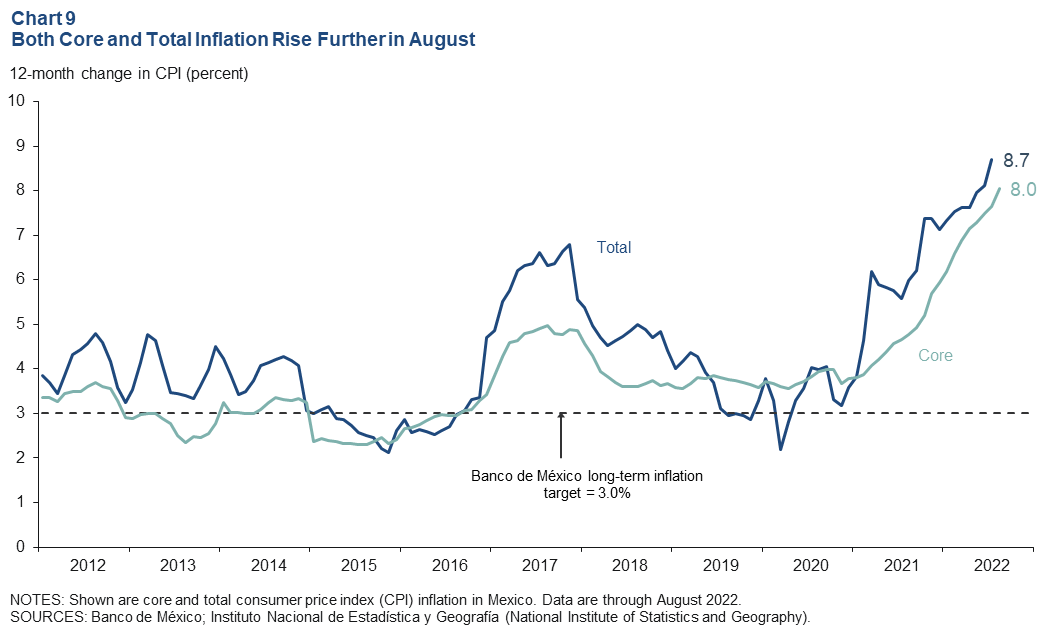
Mexico’s Consumer Price Index (CPI) rose 8.7 percent in August over the previous 12 months after rising 8.1 percent in July (Chart 9). Core CPI inflation (excluding food and energy) rose 8.0 percent in August over the previous 12 months. In September, the Mexican central bank increased interest rates by 75 basis points to 9.25 percent. In the public announcement on the interest rate decision, the central bank cited the ongoing tightening of the global financial situation and the increasing uncertainty about the outlook as reasons for the increase.
About the authors

Jesus Canas
Cañas is Senior Business Economist in the Research Division of the Federal Reserve Bank of Dallas.

There’s a pillory
Pranger is a Research Analyst in the Research Department of the Federal Reserve Bank of Dallas
The views expressed are those of the authors and should not be attributed to the Federal Reserve Bank of Dallas or the Federal Reserve System.
Comments are closed.