


The war on inflation is unlikely to trigger a global recession, but a recession could still occur due to other problems in the international economy.
While growth is slowing in many top economies, government policymakers can still avert a global recession by taking the right steps. © Getty Images×
In short
- Low inflation is not enough to ensure a resumption of robust economic growth
- Excessive government debt, regulation and taxation discourage private investment
- Policymakers have convinced business owners that inflation will continue to fall
Contrary to previous forecasts, most experts today believe that the fight against inflation will not provoke a full-scale recession. Current concerns focus more on the consequences of the economic slowdown in China than on the development of Western economies. Nevertheless, growth in the West remains anything but outstanding. In the United States, gross domestic product (GDP) is expected to grow by less than 2 percent in 2023 and by less than 1 percent in 2024, while GDP growth in the 27-nation European Union is expected to be around 1 percent in 2023 1 percent and will be 1.5 percent in 2024 percent the following year.
Most forecasters take a demand-driven approach. Overall demand (consumption plus investment) is strong and supply has followed, while higher interest rates have not had a devastating impact. Shocks such as Russia’s war against Ukraine and supply chain problems related to Covid-19 have not been the harsh impacts feared.
In this context, American GDP could be weighed down in the coming years by lower private consumption, which will suffer from debt service and lower government spending (tighter budgets). Meanwhile, the dynamics of EU growth will show opposite signs for rather vague reasons, including lower energy prices, Brussels-backed expansion programs and expectations that nominal interest rates have almost peaked, sparing the weakest member states. In fact, one suspects that most observers are simply hoping that Germany will return to growth in 2024 and lead Europe out of stagnation. In reality, this could be an exercise in wishful thinking.
This report argues that while the war on inflation is unlikely to trigger a global recession, it could still occur for other reasons.
The connection between growth and inflation
First, let’s examine the connection between growth and inflation. Growth is defined by the value of production, which in turn is driven by the quantity and quality of fixed investment (equipment and machinery). There is no doubt that those who risk their capital on long-term production ventures want to make good money. Inflation and interest rate manipulation are the opposite of sound money. Inflation is bad for growth, and any efforts to get rid of it are welcome, period. However, low inflation is still inflation.
Furthermore, the monetary conditions that arise during a war against inflation are temporary. Buyers’ purchasing power and preferences remain unstable and producers are extremely vulnerable to errors such as incorrect selection of products and production quantities. If producers believe that regulation and fiscal policy (taxes and subsidies) will also become more volatile when inflation is high, their entrepreneurial spirit will suffer even more.
The good news is that central bankers have managed to convince business leaders that inflation is under control and will soon fall below 3 percent. This does not mean that the entrepreneurs are right, but it does mean that they are willing to take risks, replace their outdated equipment and expand production prudently. This explains why the fight against inflation has not hindered wealth creation and prevented episodes of brutal recession.
As already mentioned, high interest rates and the end of loose monetary policy are unlikely to lead to a recession. However, a recession remains possible for at least three interrelated reasons: a sovereign debt crisis, declining private investment, and excessive regulation and taxation.
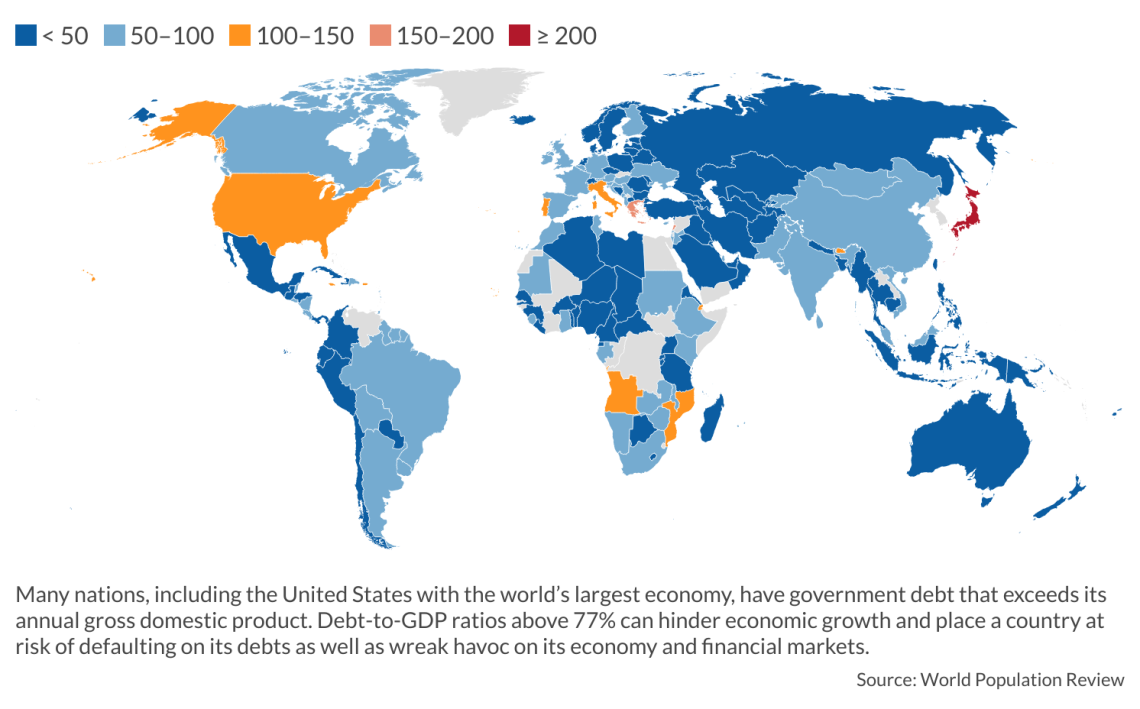
In the recent past, ever-increasing government spending has contributed significantly to ensuring that low growth or stagnation does not appear in the official figures and can be considered a recession. As a result, the public finance situation in several major Western economies remains critical and in some cases has even worsened.
×
Facts
The debt ratio of nations (2023)
Will nations reduce their national debt and spending?
With elections around the corner, both in the US and the EU, will politicians do what is necessary and cut public spending? If not, three equally alarming possibilities open up.
The first possibility is that if taxes are increased, household savings will suffer and resources available for private investment will dry up. Some observers will describe the fallout as an aggregate demand issue and may call for even greater government intervention to stimulate the economy. In fact, production and productivity would fall (recession) and inflation would possibly follow.
Second, inflation will accelerate as government debt rises and authorities resort to printing money to finance it. The credibility of policymakers will be shaken and uncertainty will paralyze economic activity. That wouldn’t be a recession. It will be a meltdown.
Finally, as national debt increases and governments try to finance it through the market, interest rates will rise. Here too, household savings will finance public spending rather than entrepreneurial ideas.
The problem with regulation and corporatism
Regulation is increasing. Recommendations to expand economic freedom have been pushed aside in favor of corporatism, a framework in which governments and powerful economic actors work together to prevent competition. Corporatism is already the norm in some industries such as banking, energy and agriculture.
Regulation is a heavy burden for all producers. Compliance is expensive and uncertainty about future regulations increases business risk. In other words, regulation is inefficient, but because some producers suffer more than others, regulators always find vocal supporters – those who work with regulators – and face disorganized and scattered opponents.
Regulation tends to increase with inflation: those who lose from rising prices seek government help and protection, while those who win seek to protect their rents. Political pressure for administrative solutions grows, government bureaucracy grows, and bureaucrats impose even more regulations to justify their role, regardless of the outcome.
The good news is that successfully fighting inflation tends to slow the rate of bureaucratic expansion. Unfortunately, however, widespread belief in big government plans (like NextGenerationEU) plays a bigger role than inflation. It strengthens the corporatist drive and opens new horizons for regulatory expansion. Regulators could easily spell the death knell for Western growth, and tackling inflation will not stop their advance.
×
Scenarios
To avoid a crash, a trend reversal is necessary
Fighting inflation promotes growth and certainly contributes to a soft landing. Still, it would be a mistake to believe that growth will resume once the battle against high inflation is won. Growth results from the interaction of innovation, competition, profit motive, entrepreneurship and, as already mentioned, the existence of sufficient private savings to finance private investments.
All of these components do not appear on the checklists of Western leaders. Today, innovation is justified when it is supported and approved by government authorities. Corporatism has replaced competition, profit-making is despised, household wealth is tolerated only if it can be used to finance public spending, entrepreneurship is mobilized to gain privileges and discouraged from productive purposes.
Future scenarios will therefore be characterized by a clear problem and many ambiguities.
What is clear is that unless the trend reverses, limited productive investment will turn a soft landing into a soft crash. This applies to Europe and the USA and has nothing to do with the consequences of an unexpectedly tight money supply, weak aggregate demand or energy prices. These prices are likely to rise and impact production in various industries only because governments have convinced fossil fuel producers to stop investing and increase supply.
The search for new scapegoats will soon intensify.
For industry-specific scenarios and tailored geopolitical information, contact us and we will provide you with further information about our consulting services.

Sign up for our newsletter
Get insights from our experts in your inbox every week.
Comments are closed.