


WASHINGTON – First it was Washington DC and New York City. Later it was Martha’s Vineyard. In recent weeks, the major immigration debate has reached a new level as Republican governors from Arizona, Florida and Texas have shipped asylum seekers to more liberal Democratic enclaves. The argument behind their movements was simple, the people crossing the border are a problem to be dealt with.
But a closer look at the numbers surrounding the country’s immigration and workforce, particularly since the Covid pandemic, raises questions about this theory of the case.
Even before the pandemic, net international migration to the United States had slowed, according to the US Census.
In 2015 and 2016, the United States saw a net increase in international migration of more than 1 million people. It dropped to about 930,000 in 2017 and fell to just over 700,000 in 2018. By 2020, the year the pandemic arrived, it was under 500,000. And last year the number dropped to about 247,000.
This is a massive and sudden drop that, among other things, has drained many potential workers from the US economy and would inevitably have ripple effects. Some of these effects have been masked by the disruptions of the pandemic, as businesses have closed and unemployment rates have risen.
But one of the key features of the US economy’s restart was a labor shortage, an abundance of “Help Wanted” signs in the windows of retailers, restaurants and other businesses in communities across the country.
You can see the signs of this shortage in the Bureau of Labor Statistics labor force participation rate.
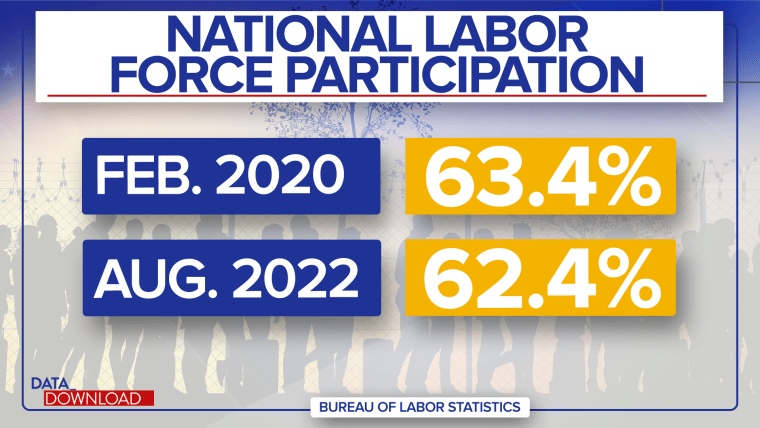
That figure for August was 62.4%, down one percentage point from February 2020. One percentage point may not sound like much, but it equates to about 2.6 million fewer people who are employed or actively looking for a job compared to February 2020.
And that figure of 62.4% is historically low. The last time the labor force participation rate reached this number (before the pandemic) was for a month in September 2015. Before that, you have to go back to the late 1970s to see a number this low.
Post-Covid challenges are particularly pronounced in some of the country’s larger cities, according to the Bureau of Labor Statistics.
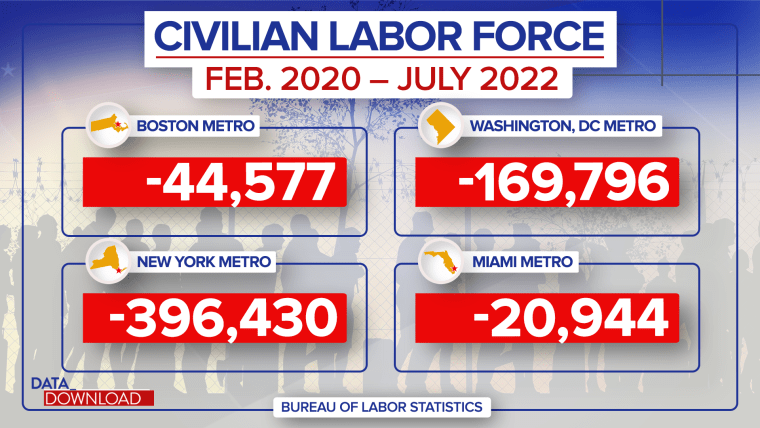
In the Boston metro area, the civilian workforce is still about 45,000 fewer workers than in February 2020, according to BLS data. In metro Washington DC, a larger area, the workforce is down nearly 170,000 compared to February 2020 . And in the huge New York subway, the workforce has fallen by almost 400,000. Pandemic.
And it’s not all northern cities. Metropolitan Miami has lost about 21,000 workers from before the pandemic.
Boston, Washington DC and Miami had unemployment rates at or below the national level in the most recent record. At the very least, the numbers suggest these are very tight job markets that could probably use an infusion of potential workers.
And new workers are critical to the larger US economy beyond current labor shortages.
The United States has an aging population, an aging workforce, and a declining birth rate. These factors collectively affect a variety of government programs, but the impact could be most profound on Social Security, which relies on a steady stream of new workers who continue to pay into the system to keep it afloat.
The problem becomes clear when one looks at the ratio of employed persons to social security beneficiaries.
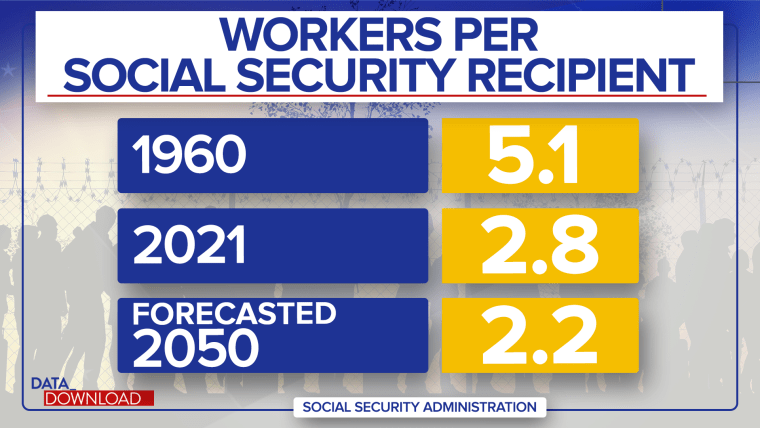
In 1960 there were 5.1 workers for every social security beneficiary. That number steadily declined through the 1970s and 1980s and currently stands at 2.8 workers per recipient, according to the Social Security Administration. Over the 30 years, the number is expected to drop to around 2.2 workers per recipient.
The math is not very complicated. Eventually, longer life expectancies and lower birth rates combine to create a massive problem for the program. Without more workers in the economy, the day of reckoning will likely come sooner.
To be clear, the governors who moved the asylum seekers, Ron DeSantis of Florida, Doug Ducey of Arizona, and Greg Abbott of Texas, were trying to make a political mark or pull a political stunt, depending on how you look at it . Bus and planeloads of immigrants were shipped elsewhere without consulting or coordinating with the local governments at their destinations. The goal was to create chaos.
But the larger idea behind all the buses and planes, that the asylum seekers are problematic or a nuisance, may be missing a larger truth. The data suggests that the United States is currently in dire need of workers.
And once settled, the immigrants that governors ship to bluer political countries can become an asset to those communities and the larger US economy.
Comments are closed.