
Is Russia's economy holding up well to the sanctions caused by the war against Ukraine? China is watching and wants to know how it works


Moscow said its economy grew 5.5 percent year-on-year in the third quarter of 2023, and Russia is expected to grow 3.5 percent for the full year.
The European Commission also raised its forecast to a 2 percent increase from the previous estimate of a 0.9 percent decline. The bloc expects the Russian economy to grow by 1.6 percent this year and in 2025.
According to the Center for Research on Energy and Clean Air in Finland, China, India, South Korea and Turkey have been the four largest buyers of Russian coal since November The EU imposed sanctions in 2022.
'A decent level': Putin praises trade with China after $200 billion target fails
The data showed that China, India and the European Union (EU) were the main buyers of Russian crude oil, while the EU also led the way in purchases of Russian liquefied natural gas (LNG), followed by China and Japan.
But despite the expected pick-up in economic growth, headwinds are likely to persist and Central Bank Governor Elvira Nabiullina has warned that Russia must be prepared for further sanctions from the West.
Russia is also still facing capital flight, high inflation and a declining labor force.
And despite many differences between the two economies, Russia's economic performance since the start of the war could still provide some references for China, which has upped the ante in its economic and technological rivalry with the United States
If there is something China can draw from, it is the need to keep leading companies and key parts of supply chains within China, Oleg Deripaska
China is also trying to find a balance between the pursuit of self-reliance and greater integration into the global market.
Oleg Deripaska, Russia's former richest man and founder of aluminum producer Rusal, said in an interview with the Chinese magazine Phoenix Weekly in early December that Russia's experience could serve as a reminder to China to diversify its trade and make the domestic economy more resilient to possible surveillance Sanctions.
And according to Liu, Chinese manufacturers should try to expand the domestic market as quickly as possible; outside of semiconductors and other high-end technologies, that would take significantly more time.
“If there is anything China can draw from, it is the need to keep leading companies and key parts of supply chains in China in the worst-case scenario of a major power play, such as war,” he said.
03:42
Ukraine says a Russian attack killed over 50 people in one of the deadliest attacks of the war
Ukraine says a Russian attack killed over 50 people in one of the deadliest attacks of the war
Circumventing possible sanctions can only succeed if there is room for trade volumes from new markets and industries as well as the support of resource-rich partners – a lesson that many Chinese industry insiders like Liu and Russian insiders are learning from Russia.
Russia is rich in resources in terms of oil, natural gas, coal, metals and timber and is a major supplier of crops and fertilizers. However, the country relies heavily on imports for everything from manufacturing equipment to consumer goods.
China also relies heavily on resources and energy abroad to fuel its economic growth, but faces growing challenges posed by geopolitical complications and the Western-led rebalancing of global supply chains as it seeks to curb over-reliance on the Chinese market reduce, be caused.
Beijing has long sought to diversify its energy and resource imports while also seeking to increase self-reliance by expanding domestic exploration and mining of precious metals and marine resources and by switching to green energy.
China and Russia strengthen “borderless” partnership and commit to cooperation on AI
In addition, the country has redoubled its security efforts on almost all economic fronts and is aware of the increasing risks caused by global market turmoil and geopolitical complications, especially the increasing restrictions and containment efforts led by the US.
China is seeking to expand the potential of a resilient and large domestic market supported by an emerging middle class of at least 400 million people, and to use this as a key pillar of its dual circulation strategy.
The strategy focuses more on the domestic market and at the same time is less reliant on the export-oriented development strategy, but without completely abandoning it.
China is also seeking further integration into the global market, with a particular focus on rules, industry standards and high value-added sectors.
Russia still faces challenges such as building and modernizing its own production capacities and technologiesAnna Kireeva
When it comes to banking and finance, Russia is capable of weathering the storm caused by Western sanctions and becoming more self-reliant.
Russia has also managed to diversify its economic ties and find alternative sources of imports and exports, said Anna Kireeva, associate professor of Asian and African studies at the Moscow State Institute of International Relations.
Such diversification “is likely to continue at least in the medium term, but probably also in the long term,” Kireeva said.
“However, Russia still faces challenges such as building and modernizing its own production capacities and technologies within the framework of import substitution policies or building new infrastructure to expand its export capacities to avoid infrastructure bottlenecks in the Far East,” she said.
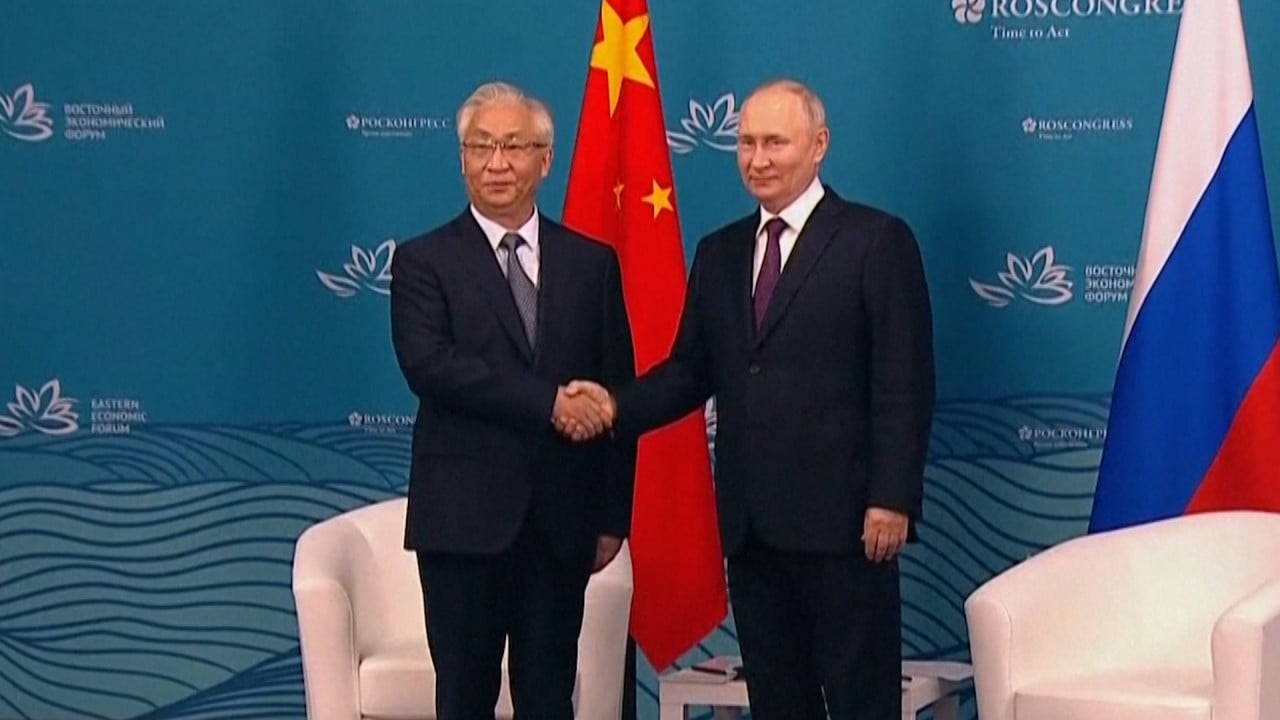
01:28
Putin says relations with China have reached an “unprecedented level.”
Putin says relations with China have reached an “unprecedented level.”
Kireeva said China needs to seek indigenous technologies, reduce dependence on technology transfers from the West and expand the use of the Chinese yuan in the global payments network.
Amid their respective tensions with the US-led West, trade between China and Russia has surged under their so-called “no limits partnership” since the start of the Ukraine war.
During the same period, China's exports to its northern neighbors rose 51 percent while its shipments to other trading partners fell, including a 13.8 percent drop to the US and an 11 percent drop to the EU.
China and Russia are paving an even stronger “financial path” with a new agreement and state visits.
If momentum continues, trade between Russia and China is expected to reach a record high of $240 billion throughout 2023.
“It’s very impressive,” said Gong Jiong, a professor at the University of International Business and Economics in Beijing.
Gong added that Russia is quickly catching up with South Korea and Japan in terms of trade value with China and could overtake the two Asian heavyweights “within a year or two.”
To deal with the impact of the next round of sanctions, the Russian Finance Ministry announced in mid-December that it would abolish the export tariff on oil from the beginning of January, while simultaneously reducing tariffs on LNG exports.
However, Gong said it remains to be seen whether Russia can sustain its economic growth in the long term.
China's economy, he added, is significantly more integrated into the global economic system and Beijing should properly manage relations with its key trading partners.
It is important to avoid decoupling, remain neutral in international affairs and maintain friendly relations with resource-rich countries while strengthening economic ties with Western nations, Gong said.
“Markets on both sides are important,” he said. “It is equally important to be independent and to further diversify suppliers.”
Let's not exaggerate Russia's situation while China is still firmly committed to opennessZheng Yongnian
Economists and policy advisers also said unwavering openness remains important and is core to China's strategic goal of becoming a moderately developed country.
China strives to achieve its goal of reaching the per capita income level of a Become a medium-developed country by 2035 – with a per capita gross domestic product of at least US$20,000.
“Let's not exaggerate Russia's situation while China is still firmly committed to openness,” said Zheng Yongnian, a prominent political scientist at the Chinese University of Hong Kong in Shenzhen.
“Energy, military and food, Russia's self-sufficiency is an inherent advantage, China is difficult in this regard.”
Furthermore, unlike Russia, China is a highly market-oriented country, he added.
Canberra will “not oppose” China’s CPTPP trade deal offer.
“If you don’t open up, you will only fall behind in the long run,” Zheng said.
Beijing also wants to strengthen global cooperation in technology and innovation and attract more international experts.
Aleksei Chigadaev, a former visiting lecturer in comparative regional studies at the Higher School of Economics in Moscow, said China also needs to be better prepared to deal with unexpected risks.
You're on your own. Sink or swimAleksei Chigadaev
“China's economy needs controlled economic shocks – bankruptcies of large companies, followed by lawsuits and the closure of inefficient banks,” Chigadaev said.
“This could serve as evidence that in complex geopolitical moments, governments do not have the luxury of solving problems manually and that companies must find solutions independently.
“You're on your own. Sink or swim. China has friendlier regimes than Russia and has better developed transportation and financial infrastructure, making sanctions less effective.”
Russia relies mainly on oil and mineral resources, while China has a wide range of goods that influence markets around the world, including the US and EU, he added.
“Sanctions against Russia are a shot in the arm and will hit ordinary consumers in the EU due to rising fuel costs. However, sanctions against China are a frontal attack,” Chigadayev said.
Additional reporting by Mia Nulimaimaiti
Comments are closed.