


sylendrahoode
introduction
In recent years, the Indian economy has seen remarkable advances in the financial and technology sectors, so the fund mainly has exposure to these sectors. There are also issuers from the energy and consumer goods sectors. The Indian economy is growing fast and it has the resources to become one of the three world market leaders. First of all, by investing in production, it is possible to climb into the top 3 of the world market leaders. India, for example, has increased its capital investments year after year. Also, Moody’s raised the estimate of India’s economic growth for 2023 to 5.5% from 4.8%, only on the backdrop of a sharp increase in budgetary investment spending. The IT industry, especially services and digital solutions, as well as the financial sector are becoming the engines of the economy. In general, the iShares MSCI India ETF (Bats: WHERE) stands out from most other emerging markets funds for its corporate earnings growth rate and its financial and technology focus. But the outlook for India’s economy has impacted a key weakness of Indian companies: their overvaluation. And that’s pretty much the only flaw. We can also add that many Indian companies, especially technology companies, are facing stiff competition both domestically and internationally, which is already having a negative impact on their profitability. Added to this is the pressure from the tight monetary policy of the Indian central bank.

Finance (refinitive)
fund information
It follows the MSCI India Index, which covers 113 mid and large cap companies listed on the Indian Stock Exchange.
- 99.71% of assets are invested in index securities, 0.29% in the BlackRock bond fund (dollars + US Treasuries with a maturity of 1 year or more) and held in Indian rupees;
- Asset $4.5B (-15% YoY);
- fee – 0.64% (management fee – 0.64%; for fund expenses – 0%);
- Rebalancing – every six months.
To know the fund’s prospects, we need to understand what it’s based on. Below we take a closer look at the industry on which the fund is based.
Sales growth forecast (refinitive)
Financially. Forecast for revenue growth in 2023: 8.3%, earnings – 8.5%, but for 2024 we expect revenue growth to slow to 2.1% as the potential to increase interest income is exhausted. This is also appropriate for India – the central bank has been raising interest rates since May 2022, the rate of increase will continue to be slower as inflation is already close to the upper limit of the central bank’s target range, and there is no point in raising it intensively.

S&P500 (Refinitive)
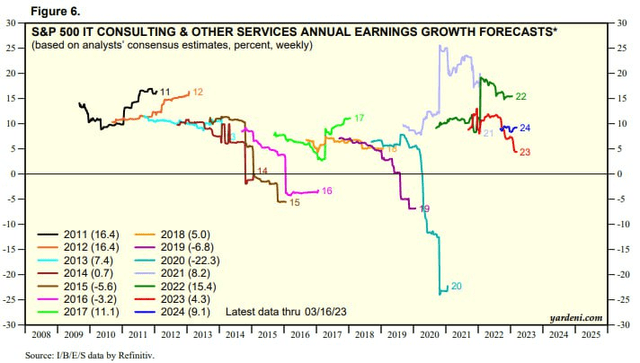
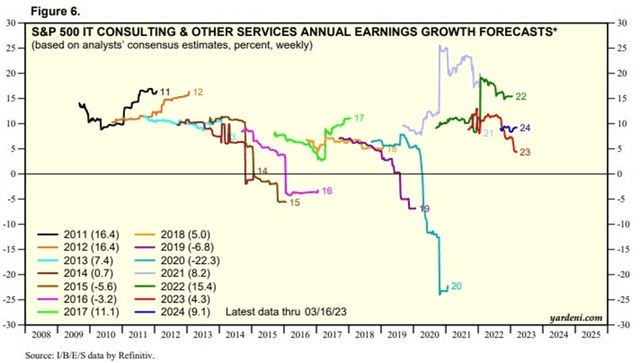
Technology, IT services and consulting. The forecast for sales growth in 2023: 4.3%, which is associated with a slowdown in demand for products against the backdrop of recessionary sentiment. For 2024, the forecast is slightly better: Revenue growth of 5.6% and earnings growth of 9.4%, all in line with the 10-year average. Growth is constrained by competition from US and Chinese rivals.
S&P Sector (Refinitive)
Energy, oil and gas production. The outlook for the next 2 years for earnings and sales growth is negative due to continued inflationary pressures, ongoing ACP tightening and pressure on operations. In addition, India is characterized by significant oil imports (75-77% of the country’s consumption), so the growth rate of Indian oil and gas is still not comparable to that of Russia or the United States, and is mainly aimed at oil refining.

S&P500 (Refinitive)
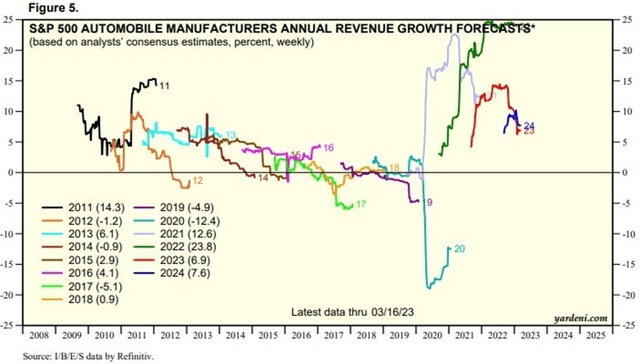
consumers, automakers. Revenue growth forecast for 2023: 6.9%, profit down 12.8%. 10-year sales average profits at 10-year lows, driven by a decline in product demand in a difficult macro environment and rising vehicle production costs. The ongoing economic recovery in 2024, marked by a new growth cycle in car demand, is embedded in a more positive earnings outlook for 2024 (+18.6%).
S&P500 (Refinitive)
Market Overview
India’s economy is growing rapidly and has the resources to become one of the top three in the world. Moody’s raised its estimate of India’s economic growth for 2023 to 5.5% from 4.8%, only on the backdrop of a sharp increase in budgetary investment spending. For 2023-2024, capital expenditure is projected at Rs. 10 trillion or 3.3% of GDP. The GDP growth forecast for 2024 is 6.5%. Barclays also raised its GDP growth forecast for 2023 to 6.3% from 6%, but linked it to lower global interest rates and cheaper commodities. The attractiveness of the Indian economy, as well as the ETF itself, can indirectly be determined by record foreign investments: for the period 2021-2022, foreign direct capital inflows of USD 84.8 billion were the highest ever. Add to this the benefits of the country’s abundance of cheap labor and the country’s low cost of production, leading multinationals to consider India as an option for locating their manufacturing facilities.
The IT industry, especially services and digital solutions, as well as the financial sector are driving the development of the economy. The country is a world leader in the availability of financial services; For example, in 2021 more than 40% of global real-time payment transactions were processed. Therefore, the presence of companies from these two sectors in INDA is justified. Reliance’s 10% stake in the energy sector is somewhat surprising, but it hints at the hidden potential of Indian oil producers and refiners. The country is the third largest oil consumer in the world; projected demand for black gold by 2030 will increase by 50% compared to 2019 (up to 7.2 million barrels per day); the demand for natural gas will double to 133 billion cubic meters in the same period. Currently, local oil companies provide about 23% of demand and are in the third top ten in terms of global production, with the rest being imported. The growth of the economy and the goal of increasing the share of gas in the country’s energy balance to 15% by 2030 open up opportunities for the development of Indian oil and gas.
Disadvantages and Rating
The outlook for the Indian economy has impacted a key disadvantage of Indian companies – their overvaluation. The forward P/E of the MSCI India Index is 19, almost double that of Chinese stocks and twice that of the MSCI EM Index. That’s expensive even compared to the S&P 500 (FWD P/E 2023 17.3). That’s despite the local index falling more than 25% from its 2021 highs. The Reserve Bank of India raised interest rates to 6.5% for the sixth consecutive month in February as consumer inflation exited its 2-6% target range. The government has instructed the central bank to keep retail inflation at 4% over a five-year period until March 2026. To this end, the central bank intends to further increase the rate to control inflation. That’s good for banks earning interest income, but stressful for businesses faced with rising costs. Many Indian companies, particularly technology companies, face stiff competition both domestically and internationally, which is already affecting their profitability. Added to this is the pressure from the tight monetary policy of the Indian central bank.
bottom line
Overall, INDA’s corporate earnings growth rate and financial and technology focus sets it apart from most other emerging markets funds. The key downside is the high valuation, which is evident both at the macro level and when looking at individual companies. INDA is now at $38-40 support and unlikely to go lower without a massive US recession. In any case, it is one of the best options among EMs.
Comments are closed.