


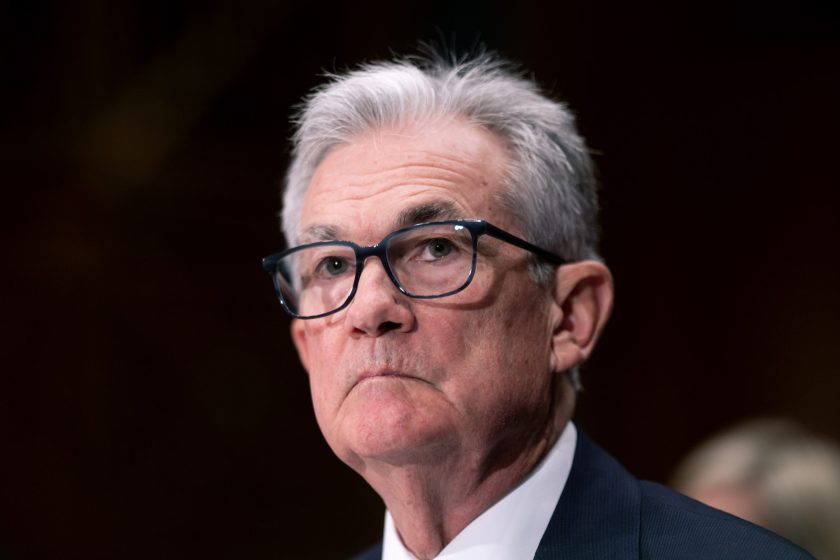
US Federal Reserve Chairman Jerome Powell. Nathan Howard/Bloomberg via Getty Images
The campaign to fight US inflation by raising interest rates has been going on for a year and a half – and its impact is being felt around the world.
On July 26, 2023, the Federal Reserve announced another quarter-point rate hike. This means that US interest rates have increased by 5.25 percentage points over the last 18 months. While inflation is falling in the US, aggressive monetary policy could also have a significant longer-term impact on countries around the world, particularly in developing countries. And that is not good.
I study how economic phenomena such as banking crises, periods of high inflation and rising interest rates affect countries around the world, and I believe this prolonged period of higher US interest rates has increased the risk of economic and social instability, particularly in lower-income countries.
waves around the world
Monetary policy decisions in the US, such as raising interest rates, have a knock-on effect on low-income countries, not least because of the dollar’s central role in the global economy. Many emerging markets rely on the dollar for trade, and most borrow in US dollars – all at interest rates influenced by the Federal Reserve. And when US interest rates rise, many countries – and especially developing countries – tend to follow suit.
This is largely due to fears of currency devaluation. The increase in US interest rates means that US government and corporate bonds appear more attractive to investors. The result is uncontrolled outflows of foreign capital from emerging markets, which are perceived as riskier. This pushes these countries’ currencies lower, prompting governments in lower-income countries to scramble to emulate Federal Reserve policies. The problem is that many of these countries already have high interest rates, and further rate hikes limit governments’ ability to borrow money to expand their own economies – increasing the risk of a recession.
Added to this is the impact that interest rate hikes in the US have had on countries with high levels of debt. When interest rates were lower, many lower-income countries took on large amounts of international debt to offset the financial impact of the COVID-19 pandemic and later the impact of higher prices caused by the war in Ukraine. But rising borrowing costs are making it harder for governments to make repayments that are due now. This condition, known as the “debt crisis”, is affecting more and more countries. David Malpass estimated in May 2023, when he was still President of the World Bank, that about 60% of low-income countries are in or at high risk of a debt crisis.
More broadly, any attempt to slow growth to bring down inflation in the US – which is the intended goal of the rate hike – will have a domino effect on the economies of smaller countries. As the cost of borrowing rises in the US, businesses and consumers will have less cheap money to spend on all commodities, whether domestic or international. Meanwhile, any fears that the Fed has slammed on the brakes too quickly and is risking a recession will further dampen consumer spending.
The risk of a spillover
This is not just theory – history has shown that it is true in practice.
When then-Fed Chairman Paul Volcker fought domestic inflation in the late 1970s and early 1980s, he did so with aggressive interest rate hikes that pushed up the cost of borrowing around the world. It contributed to the debt crisis in 16 Latin American countries and led to what became known in the region as the “lost decade” – a period of economic stagnation and rising poverty.
Current interest rate hikes are not of the same magnitude as in the early 1980s when interest rates rose to nearly 20%. But interest rates are high enough to spark fears among economists. The World Bank’s recent report on the global economic outlook included an entire section on the impact of US interest rates on developing countries. It states: “The rapid increase in interest rates in the United States presents a significant challenge [emerging markets and developing economies]The result is a “higher likelihood” of financial crises in vulnerable economies.
The wealth gap is getting bigger
Research I have conducted with others suggests that the financial crises suggested by the World Bank – currency depreciation and debt crisis – can destroy the social fabric of developing countries by increasing poverty and income inequality.
Income inequality is at an all-time high, both within countries and between richer and developing countries. The World Inequality Report 2022 finds that the richest 10% of the world’s people currently take home 52% of total global income, while the poorest half of the world’s population receives just 8.5%. And such wealth inequalities are deeply destructive to societies: inequality in income and wealth has been shown to both damage democracy and reduce popular support for democratic institutions. It has also been linked to political violence and corruption.
Financial crises – such as those triggered by higher interest rates in the US – increase the likelihood of an economic downturn or even a recession. Worryingly, the World Bank has warned that developing countries are facing a “multi-year period of slow growth” that will only increase poverty rates. And history has shown that the impact of such economic conditions hits hardest on the low-skilled and low-income.
This impact is exacerbated by government policies such as spending and government service cuts, which in turn disproportionately affect the less well-off. And if a country is struggling to pay off its national debt because of higher global interest rates, then it also has less money to help its poorest citizens.
Quite literally, a period of higher interest rates in the US can be detrimental to the economic, political and social wellbeing of developing countries.
However, there is a caveat. As US inflation slows, further rate hikes are likely to be limited. It could be that while Fed policy hasn’t slowed the US economy too much, it has nevertheless laid the groundwork for potentially more serious economic – and social – problems in poorer countries.
Cristina Bodea is Professor of Political Science at Michigan State University.
This article has been republished by The Conversation under a Creative Commons license. Read the original article.
Look at the diagram
Comments are closed.