


vOld truck driver Meng Hong has become an unlikely social media star in recent weeks. Since March, his brief video chats about life on the move during the Covid outbreaks have garnered him millions of likes on Douyin, the Chinese version of TikTok.
Most of Meng’s videos were about “spreading positive energy,” as he wrote in his account description. But on April 13, he began complaining about what was happening when drivers were transporting goods to Shanghai. “After we delivered groceries, we were quarantined [after we left] or locked up in Shanghai,” he revealed in an animated video tirade.
As China’s most populous city went into a strict lockdown this month, local governments in neighboring areas set up roadblocks and closed highways to stem the potential spread of omicron, woefully disrupting logistics chains. “Since you had a trip to Shanghai, very few other cities would allow you entry,” Meng lamented. The drivers now refused to go there, he reported.
The post resonated across China and is a microcosm of the uncertainty currently facing the world’s second largest economy. The ruling party’s zero-Covid policy has so far caused at least 45 cities to enter some form of lockdown, and Beijing is showing no signs of changing tack in its efforts to stem the spread of the virus.
‘Companies need signs of stability’
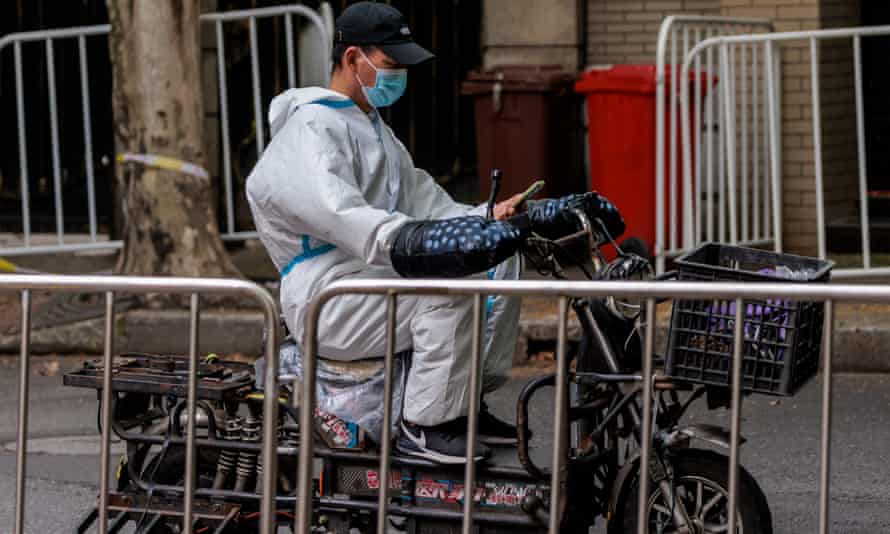 A man in protective gear rides a scooter on the street in Shanghai. Photo: Alex Plavevski/EPA
Last Sunday, residents in the six wards of Wuhu, a city of 3.6 million people in eastern Anhui Province, woke to a sudden lockdown after a student at a school tested positive the previous day. Officials say they use a three-word approach to dealing with such situations: fast, precise, and tough.
However, the unpredictability of such a practice has inevitably led to economic losses, with lockdowns affecting 50% of China’s total production, according to local economists.
Chinese and foreign companies are equally affected. According to a recent survey by the German Chamber of Commerce in China, only around 7% of the German companies surveyed report no effects of Covid-19 on their business activities in China. And when geopolitical tensions are factored in, a third of respondents said they were “on hold” of any planned business or investment in the country.
“What businesses need now are signs of stability,” the chamber said in a recent report, which also called on European Union leaders to voice their concerns to Chinese policymakers. “In the midst of the current Covid-19 wave in China, the German business community urgently needs an indication of the direction of the government’s Covid strategy to minimize the severe impact on business operations and supply chains.”
“Growth recession” warning.
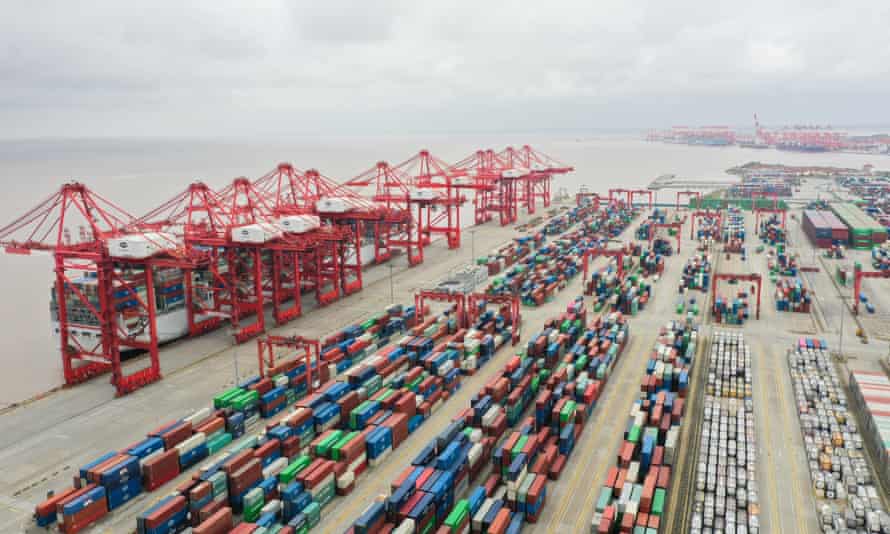 Shanghai’s Yangshan port. Photo: Xinhua/REX/Shutterstock
Beijing set its annual GDP growth target at “around 5.5%” last month, but that increasingly looks like a major challenge, economists say. Last week, the International Monetary Fund (IMF) lowered its forecast for the world’s second-largest economy to 4.4% this year as China begins to feel the effects of Russia’s invasion of Ukraine and lockdowns.
On Thursday, Nomura went even further, lowering its forecast for China’s annual growth to 3.9% this year from 4.3%. With no easing of the strict containment strategy on the horizon, the Japanese company said its base estimate was that China’s growth would increase by just 1.8% in the second quarter.
Consumption and net exports are two drivers of China’s economic growth, said Mary Lovely, director of the China program at the Peterson Institute for International Economics in Washington DC. “[But] Looking at these two drivers going forward, we see some serious danger signs,” she said, warning that China could experience a “growth recession” in the current quarter. A “growth recession” refers to an economy with slow growth but rising unemployment.
Providing economic growth has always been crucial to the legitimacy of the ruling Chinese Communist Party. This is especially true in 2022, as the party congress, which takes place every five years, is scheduled to take place in the fall. President Xi Jinping is expected to continue his rule in an extraordinary break with previous norms.
Stability – both political and economic – is key for Beijing’s rulers. But lockdowns, risk of disease and uncertainty are dampening consumption and investment that could create jobs, Lovely added.
According to China’s own data released this week, the economy has been facing headwinds since last month, when Omicron began to spread. The unemployment rate in 31 major Chinese cities hit a record high of 6% in March. Among 16-24 year olds, the unemployment rate hit 16%, the highest level in eight months.
Unemployment is a concern for the authorities, particularly among younger workers, as it fuels social discontent, Lovely said. “It also means lost experience for these future workers and lower life productivity and income. Educating young people is necessary for China to continue to sustain healthy growth despite an aging population.”
Sign up for the daily Business Today email or follow Guardian Business on Twitter at @BusinessDesk
But there is a bigger concern for Beijing. Last week, IMF chief Kristalina Georgieva warned that China’s consumption was falling short. “Instead of shifting money into public investment, shift it into people’s pockets so that there is more momentum in a consumption boom,” she suggested.
China has long sought to build a consumer-driven economy. However, economic data suggests that China is yet to see a meaningful rebound in real household income growth since the first round of the pandemic in 2020, said Jinny Yan, chief China economist at ICBC Standard Bank. “This is now being exacerbated by local lockdowns as people are physically unable to go out to consume, and March retail sales data shows that even online sales have been hit hard by supply chain and logistics disruptions.”
There is no easy way out of the current zero-Covid policy dilemma, Yan said. This means that even with monetary and fiscal support, consumer confidence is expected to continue falling. In addition, there are still structural problems in the Chinese economy.
“So there is no silver bullet. Even if the current zero-Covid policy were relaxed, a high prevalence of Covid cases will still affect economic activity.”
Comments are closed.