
As the report shows, Hispanics help boost the region's economy but face significant inequalities


December 1st, 2023
Hispanics are a growing part of the Sacramento region's economy, according to new data from Sacramento State and the Sacramento Hispanic Chamber of Commerce. Almost 70% say they work full time. But many still lack access to basic services such as medical care and health insurance.
The Hispanic Economic Report, the subject of a panel discussion at Sac State's Carlsen Center on Nov. 30, was prepared by the Hispanic Chamber based on work by the university's Institute for Social Research and provides insight into issues affecting the region's Latino population.
Sac State Interim Provost and Vice President for Academic Affairs Carlos Nevarez led the discussion analyzing the report's findings.
Panelists included Sac State faculty members Elvia Ramirez and Heidy Sarabia, who researched the report, as well as representatives from the Hispanic Chamber and the Sacramento Area Council of Governments. It also featured Rita Gallardo-Good, Sac State's senior associate vice president for public affairs and advocacy.
“We must ensure that our communities are part of the region’s growth.” – Juan Novello, vice president of the Sacramento Hispanic Chamber of Commerce
To create the report, Sac State's Institute for Social Research and Center for Business Analytics used data from the U.S. Census and other state and federal agencies. The research team and the Hispanic Chamber also surveyed community members on topics such as income, education, digital access and employment.
Nevarez said the report and panel discussion reflect the university's commitment to Latino students. Sac State is a nationally recognized Hispanic institution where more than a third of its students identify as Latino graduates. The university was awarded the coveted Excelencia Seal for its programs and policies for Latino students for the second time.
About 28% of the more than 9,000 students who graduated from Sac State this year were Latino, Nevarez said. While that number is impressive, “we still have gaps to fill,” he added, noting that the university is working to ensure its faculty better reflect the cultural backgrounds and experiences of its students.
The economic report also reflects the significant contributions that Hispanic residents make to the Sacramento region, Nevarez said, and offers “a roadmap for solutions” to the inequities affecting them.
“We need to make sure our communities are part of the region’s growth,” said Juan Novello, vice president of the Hispanic Chamber. Data is a critical part of the equation, he said, because it can spark conversations, correct misconceptions and educate people about Latino residents and their contributions and challenges.
The report's findings include:
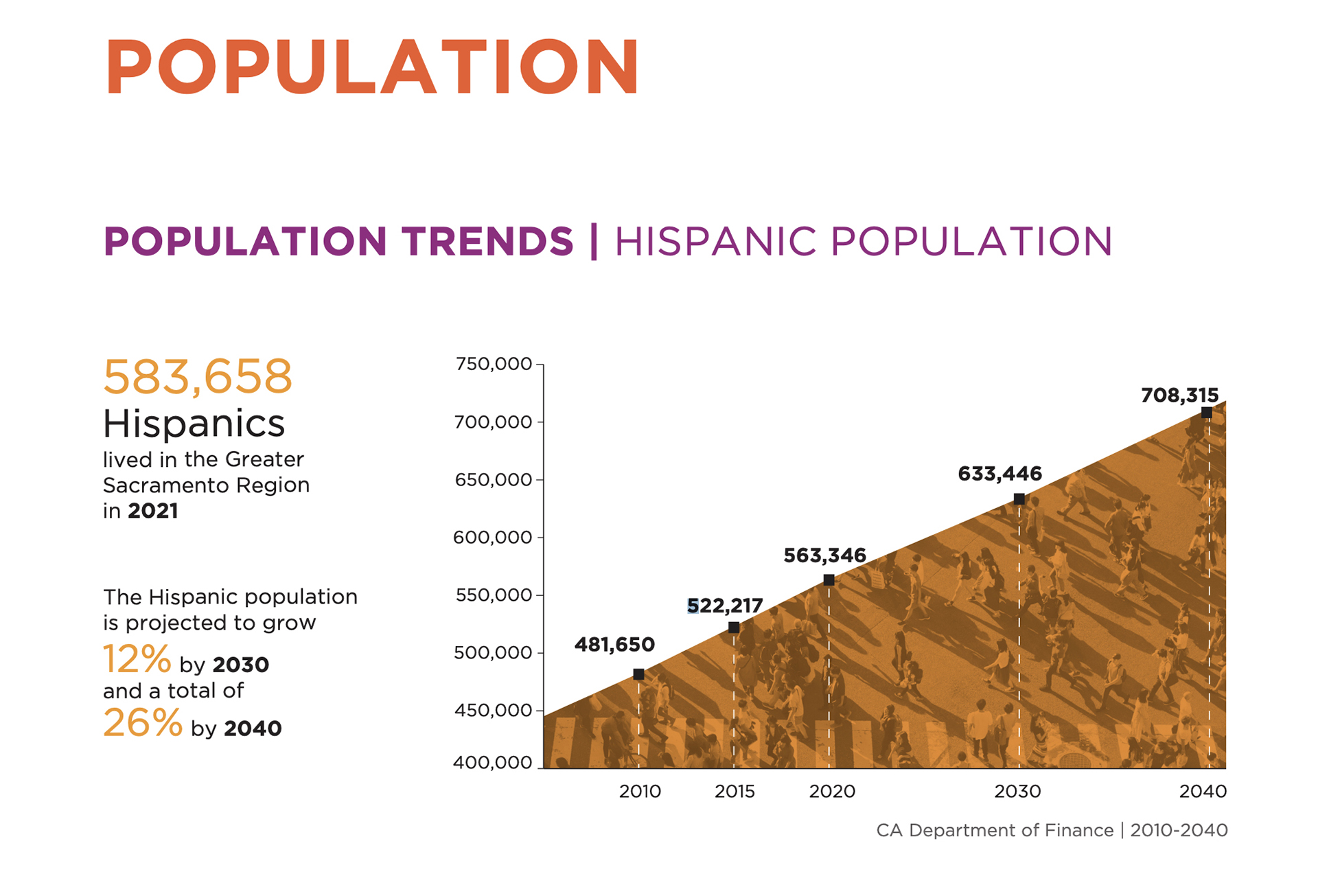
- 23% of residents in the six-county greater Sacramento region are Hispanic, a number that is expected to increase by 12% by 2030 and 26% by 2040.
- More than 60% of Hispanic adults in the Sacramento area were born in the United States and nearly 80% are U.S. citizens.
- The median annual income for Hispanic households is $68,000, compared to $81,000 for non-Hispanic households.
- While about 23% of non-Hispanic residents have a bachelor's degree, only 13% of Hispanic residents have a bachelor's degree.
Sarabia, an associate professor of sociology, pointed out that Latinos are more likely than other ethnic groups to work in jobs such as house cleaning and landscaping, which generally pay less and are less likely to offer health insurance. Fewer Latin Americans have retirement and savings accounts, and more of them report being unable to pay their medical bills.
Novello said the Hispanic Chamber plans to use the report's data to find ways to empower Latino individuals and businesses with the help of elected officials, community leaders and businesses.
Priority areas include programs and policies aimed at helping Latinos with educational attainment, financial literacy, and access to homeownership and health care.
The report highlights several initiatives designed to help achieve these goals, including the Northgate Boulevard Economic Plan; Sac State Anchor University grants that can be used to support traditionally underrepresented communities; and efforts to elect more Latinos to school boards, city councils, county executives and the state legislature.
The full report can be found at https://sachcc.org/report/.
About Cynthia Hubert
Cynthia Hubert arrived at Sacramento State in November 2018 after an award-winning career writing for the Sacramento Bee. Cynthia believes everyone has a good story. She lives in East Sacramento with her two cats, who enjoy bird watching from their perch next to the living room window.
Comments are closed.