


comment
In the Washington Post, Julian Lee reports that the United States, United Kingdom and Canada “have announced bans on Russian oil, while the European Union plans to ban sea imports of Russian crude oil by December and refined fuels by early 2023.”
Lee also notes that “the group of seven most industrialized countries has agreed to … impose a price cap on global purchases of Russian oil.” The price cap could make it harder for Russia to fund its war in Ukraine.
“The price cap is specifically designed to reduce Russian revenues and Russia’s ability to fund its war of aggression, while limiting the impact of the Russian war on global energy prices, particularly for low- and middle-income countries,” the G7 said -Minister of Finance.
However, Russia has since responded by threatening to cut oil supplies to countries that impose price caps.
“Companies that set a price cap will not be among the recipients of Russian oil,” announced Kremlin spokesman Dmitry Peskov.
The price cap aims to control the rising cost of energy prices, thereby reducing worrying inflationary pressures. However, the G7 decision to cap Russian oil prices is expected to complicate the humanitarian response to the crisis caused by the war, especially if the international community does not carefully consider the negative impact the cap is having on countries affected by this decision.
In this context, one would expect energy to become a luxury product if Russia suspended or stopped its oil supplies.
In 2021, Russia’s share of mineral fuel exports reached 8.3 percent of the total world volume, making Russia one of the top oil and gas exporters in the world. Russia is also the main supplier of metals, including copper, nickel, palladium and aluminum.
A Russian construction worker talks to a mobile phone April 9, 2010 during a ceremony to mark the start of construction of the Nord Stream pipeline in Portovaya Bay, some 170 km (106 miles) northwest of St. Petersburg, Russia. (Dmitry Lovetsky/ ` photo)
A slowing global economy
Russia’s response to the European ceiling is likely to further slow the global economy, which is desperate to avoid a recession in the next 12 months.
In its July report, the International Monetary Fund (IMF) scaled back its 2022 GDP growth forecast for 2023 and ominously called the global economic outlook “bleak and more uncertain”.
Specifically, the IMF is forecasting a slowdown in growth “from 6.1 percent last year to 3.2 percent in 2022, down 0.4 percentage points from the April 2022 World Economic Outlook.”
The report also notes that China’s “lockdowns and deepening housing crisis have led to growth being revised down by 1.1 percentage points.”
The effects of the war in Ukraine are also exacerbated by most countries’ vulnerability to existing pre-war risks, including new vaccine-resistant and highly contagious COVID-19 variants. In early 2022, countries around the world cautiously implemented measures to recover from the COVID-19 pandemic, but this process was brutally interrupted by the war in Ukraine.
For example, in commenting on the disastrous effects of the war in Ukraine on the world economy, the United Nations Development Program reported that the Middle East is “heavily dependent on Russian and Ukrainian wheat, corn and sunflower oil. Egypt, the largest country in the region, imports 80 percent of its wheat. The International Monetary Fund says inflation in the region is nearly 15 percent.”
Due to Ukraine’s extreme economic vulnerability in the event of an escalation of the war, there is a real threat of increasing poverty and famine in the developing world. This scenario can inflict deep social and economic suffering on future generations, especially in developing countries.
Is a prosperous global economy a thing of the past?
The war in Ukraine has affected the production and transportation of agricultural products. These difficulties, higher energy prices “as well as persistent imbalances between supply and demand” could reduce Ukraine’s funding from public and private sources for national development projects.
Russia and Ukraine used to be the top exporters of wheat, and the two countries provided 14.7 percent of global wheat production in 2021.
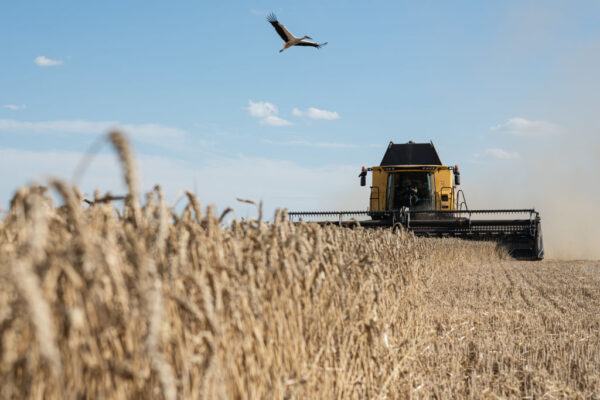 A stork flies over a wheat field as a combine harvester of agricultural company TVK Seed harvests wheat July 29, 2022 near Myronivka, Ukraine. (Alexey Furman/Getty Images)
A World Bank flagship report sums up the current precarious situation quite well:
“After more than two years of pandemic, the impact of the Russian Federation’s invasion of Ukraine will sharply accelerate the slowdown in global economic activity, which is now expected to slow to 2.9 percent in 2022. The war in Ukraine raises commodity prices, contributes to supply disruptions, increases food insecurity and poverty, exacerbates inflation, contributes to tightening financial conditions, increases financial vulnerabilities and heightens political uncertainty.”
Russia’s invasion of Ukraine has certainly worsened the outlook for the global economy. This is mainly due to higher energy prices and continued pressure on commodity prices. Economies are therefore likely to be affected by anomalies in the supply of energy and raw materials.
With the deteriorating economic outlook weighing on consumer and business confidence, buoyant activity is not expected for some time.
This bleak economic outlook poses a serious threat to peace and development around the world.
While strong and stable international cooperation is therefore required to respond effectively to these challenges, it is questionable whether bans on Russian oil and the G7 decision to impose a price cap on international purchases of Russian oil are best suited to address these challenges an easing of the current economic conditions in the world.
The views expressed in this article are the author’s and do not necessarily reflect the views of The Epoch Times.

consequences
Kashan Pirzada is Associate Professor of Accounting at Tunku Puteri Intan Safinaz School of Accountancy (TISSA). He was an Associate Fellow of the Asian Research Institute for Corporate Governance (ARICG) and a Senior Researcher at the University of Malaya. He was awarded University Utara Malaysia’s Excellence Service Award in 2020.

consequences
Gabriël A. Moens AM is Professor Emeritus Law at the University of Queensland and was Pro-Vice-Chancellor and Dean at Murdoch University. In 2003, Moens was awarded the Australian Centenary Medal for services to education by the Prime Minister. He has taught extensively in Australia, Asia, Europe and the United States. Moens has recently published two novels, A Twisted Choice (2020) and The Coincidence (2021).
Comments are closed.